
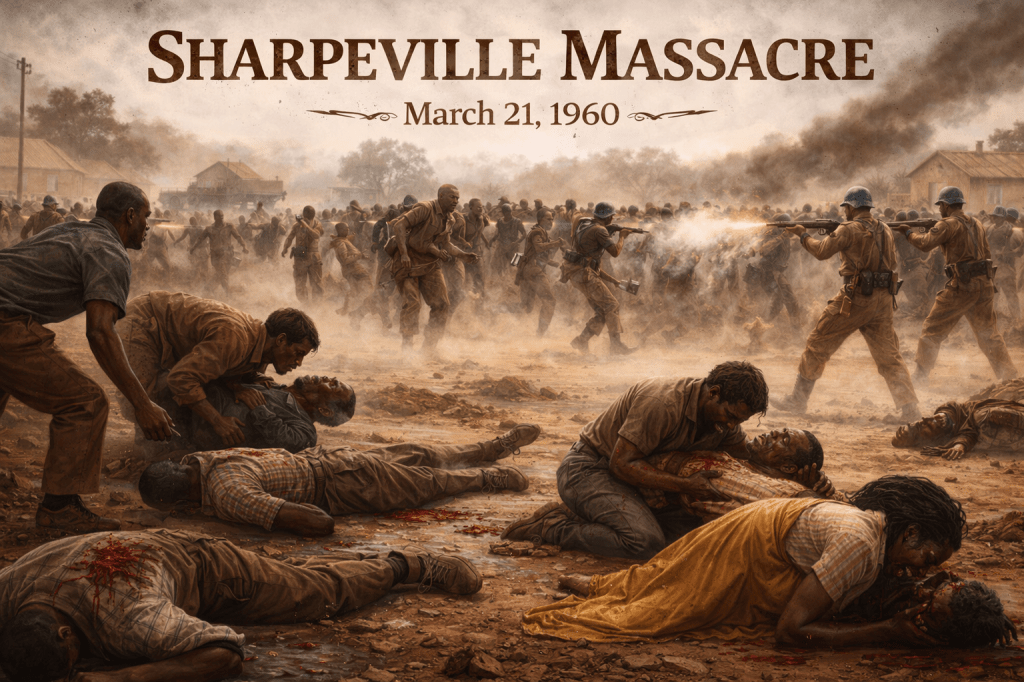
March 21, 1960
When Political English Confronted Apartheid on the World Stage
On March 21, 1960, police opened fire on a peaceful protest in Sharpeville, killing 69 people and injuring many more. The event, now known as the Sharpeville Massacre, became a turning point in global awareness of South Africa’s apartheid system. Reported widely in English-language newspapers, broadcasts, and political writing, it helped solidify a vocabulary of resistance, justice, and human rights that would resonate across the world.
1. Globalizing the Language of Apartheid and Racial Injustice
The massacre brought the term apartheid into widespread international usage, transforming it from a South African policy into a globally recognized concept.
Key linguistic consequences:
- global adoption of apartheid as a term for institutionalized racial segregation
- increased use of phrases such as racial oppression, segregation laws, and state violence
- expansion of vocabulary describing systemic injustice
- embedding of South African political terminology into international discourse
- sharper distinctions in English between legal authority and moral legitimacy
English became a primary medium through which apartheid was explained, criticized, and condemned worldwide.
2. Expanding the Vocabulary of Human Rights Discourse
Coverage of Sharpeville helped strengthen the emerging global language of human rights, particularly in the post–World War II era.
Important terms reinforced or popularized include:
- human rights
- civil rights
- international condemnation
- state repression
- freedom movements
These expressions became central to political writing, journalism, and activism in English-speaking contexts.
3. Shaping the Language of Protest and Activism
Sharpeville became a defining reference point for protest movements around the world. English-language reporting and activist writing helped standardize the rhetoric of resistance.
Key developments in protest language:
- increased use of peaceful protest, demonstration, and mass mobilization
- emphasis on nonviolent resistance versus state force
- rhetorical framing of events as turning points or watershed moments
- use of emotionally charged but precise language to describe injustice
- growth of slogans and advocacy language aimed at international audiences
This vocabulary became a template for later movements in the United States, Europe, and beyond.
4. Establishing English as a Language of Global Advocacy
Because much of the international response to Sharpeville was mediated through English-language journalism and diplomacy, English further solidified its role as a global language of political communication.
Long-term linguistic impact:
- English as a primary language of international reporting and diplomacy
- expansion of transnational activist networks using English
- increased circulation of political narratives across continents
- reinforcement of English as a lingua franca for global justice movements
- development of a shared vocabulary for discussing oppression and reform
Through these channels, local tragedy became global discourse.
Why It Matters
The Sharpeville Massacre of March 21, 1960, was not only a pivotal political event but also a defining moment in the evolution of modern political language in English. It helped globalize terms like apartheid and strengthened the vocabulary of human rights and protest that continues to shape international discourse today.
In the aftermath of Sharpeville, English became an even more powerful tool for naming injustice—and for demanding change.
When injustice was named, the world finally began to listen.
History shows when language changed.
At The English Nook, we explore how and why.
 What Happened on This Day?
Leave a comment