
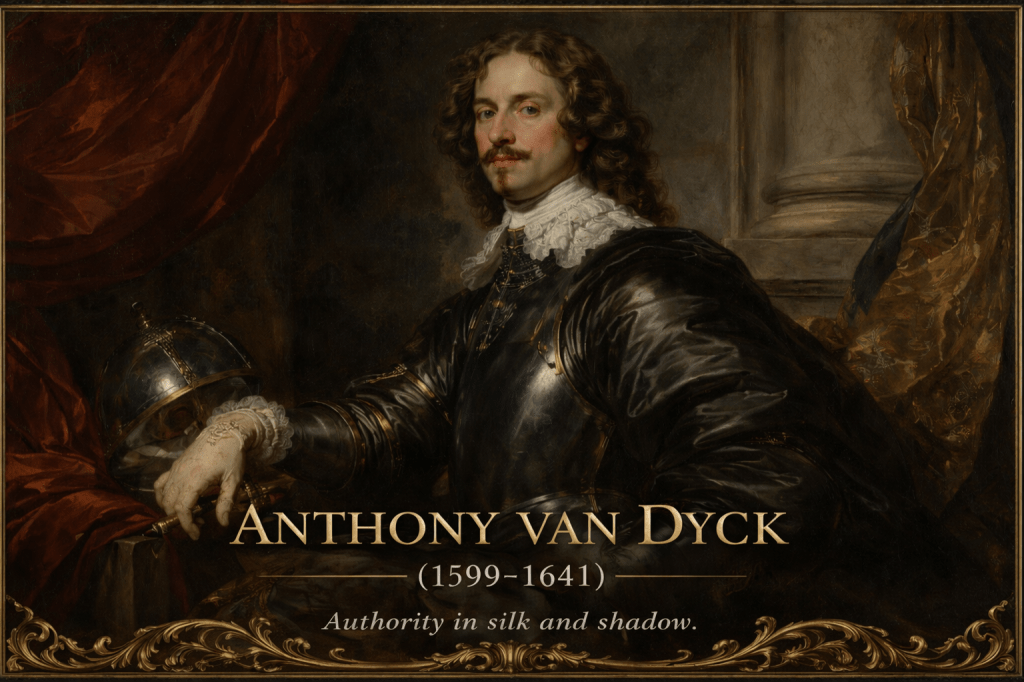
March 22, 1599
When Art Reflected a Multilingual England Becoming More English
Born on March 22, 1599, Anthony van Dyck became one of the most important painters of the Baroque era and a central artistic figure at the court of Charles I of England. His career in England reflects a cultural moment in which the country was still shaped by continental European influences—Flemish, Italian, and French—yet was increasingly consolidating English as its dominant language of power, identity, and expression. Through art rather than words, van Dyck became part of this transformation.
1. A Multilingual Court Culture
When van Dyck arrived in England, the royal court was a cosmopolitan environment where multiple European languages and cultural traditions coexisted. England was politically English, but culturally still deeply connected to Europe.
Key cultural features of this environment:
- Continued influence of French and Italian in elite culture
- Use of multiple languages in diplomacy, art, and scholarship
- Presence of foreign artists, musicians, and intellectuals
- Blending of continental and English artistic traditions
- English coexisting with older prestige languages of Europe
Van Dyck’s success in England shows how open and interconnected this court culture remained.
2. The Rise of English Cultural Authority
Despite this multilingual environment, the early seventeenth century was a period in which English was becoming more firmly established as the language of governance, literature, and national identity. Political and cultural authority were increasingly expressed in English rather than French or Latin.
Developments reflected in this shift include:
- Consolidation of English in administration and court communication
- Growing prestige of English in literature and public life
- Decline of French as a dominant language of elite authority
- Expansion of English as a marker of national identity
- Alignment of artistic patronage with an emerging English cultural voice
Van Dyck’s work, though continental in style, became part of a distinctly English court culture.
3. Art as a Language of Power
Van Dyck’s portraits of the English aristocracy did more than represent individuals—they helped construct a visual language of power. Just as political authority was expressed through language, it was also expressed through image, posture, clothing, and setting.
Connections between art and language in this context:
- Visual representation reinforcing political and social hierarchy
- Portraits functioning as cultural “texts” within court society
- Transmission of European artistic styles into English cultural frameworks
- Shared symbolic vocabulary between visual art and political expression
- Strengthening of a unified court culture across artistic and linguistic forms
In this way, artistic production and linguistic development moved in parallel.
4. Reflecting England’s Cultural Consolidation
Van Dyck’s career in England coincided with a broader transition: from a multilingual, European-influenced court toward a more self-defined national culture centered on English identity.
Long-term cultural implications:
- Gradual dominance of English across literary, political, and social domains
- Integration of foreign influences into a distinctly English identity
- Emergence of England as a major cultural center in Europe
- Alignment of artistic, political, and cultural authority
- Preparation for the later global expansion of English culture and language
His presence serves as a cultural marker of this transitional moment.
Why It Matters
Anthony van Dyck’s career in England reflects more than the success of a great painter—it marks a cultural moment in which England absorbed continental influences while increasingly defining its own identity. Through portraiture, van Dyck helped shape the visual language of power in a society where English culture and language were becoming more firmly established.
In silk and shadow, England learned how to see itself.
History shows when language changed.
At The English Nook, we explore how and why.
 What Happened on This Day?
Leave a comment