
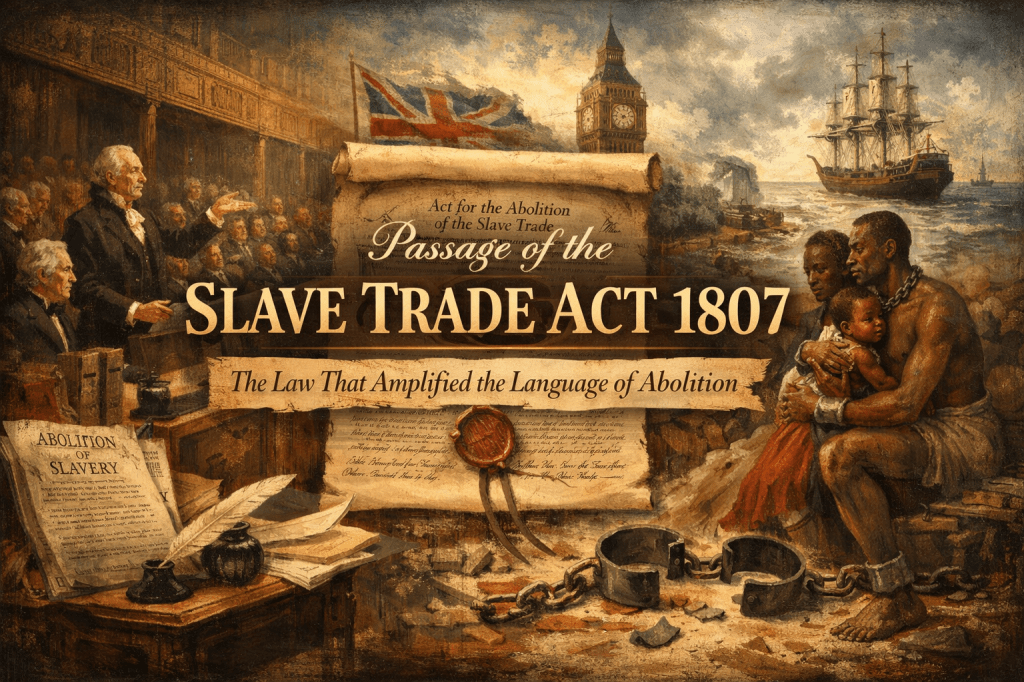
March 25, 1807
When Moral Argument Reshaped Political English
On March 25, 1807, the Parliament of the United Kingdom passed the Slave Trade Act, abolishing the transatlantic slave trade within the British Empire. While slavery itself would not be abolished until later, this landmark legislation marked a turning point in both political action and public discourse. It was accompanied—and driven—by a vast body of English-language speeches, pamphlets, petitions, and essays that helped define the moral and rhetorical vocabulary of abolitionism.
1. A Surge in Abolitionist Writing and Public Discourse
The campaign against the slave trade generated one of the most extensive bodies of political writing in early modern English. Activists, politicians, and writers used print to persuade, mobilize, and document.
Key linguistic consequences:
- proliferation of pamphlets, sermons, and political speeches
- widespread use of petitions and public letters
- development of persuasive writing aimed at moral reform
- expansion of print culture as a tool for activism
- increased participation of the public in political debate
This movement demonstrated the power of English as a language of organized moral persuasion.
2. Shaping the Moral Vocabulary of Abolition
The abolitionist movement helped popularize and redefine key ethical terms that remain central to political discourse in English.
Core vocabulary strengthened during this period:
- abolition
- human dignity
- freedom
- justice
- moral responsibility
These words took on heightened emotional and philosophical weight through repeated use in abolitionist argument.
3. Developing the Rhetoric of Human Rights
Although the modern term human rights would emerge later, the language used in abolitionist writing laid its foundation. Writers framed slavery not only as a legal issue but as a profound moral violation.
Rhetorical features include:
- appeals to universal humanity and shared moral values
- emphasis on the inherent worth of every individual
- blending of religious, ethical, and political arguments
- use of vivid, often emotional descriptions to provoke empathy
- framing of slavery as incompatible with civilized society
This style influenced later movements for civil rights and social reform.
4. Establishing English as a Language of Reform and Advocacy
Because the abolitionist movement operated across Britain, its colonies, and international networks, English became a key medium for spreading reformist ideas.
Long-term linguistic impact:
- strengthening of English as a language of activism and reform
- influence on later political movements and advocacy writing
- creation of a shared vocabulary for discussing injustice
- expansion of transnational communication through English texts
- shaping the tone of future debates on freedom and equality
This helped position English as a global language for moral and political discourse.
Why It Matters
The passage of the Slave Trade Act in 1807 marks a defining moment not only in legal history but in the evolution of English political language. The movement that produced it generated a powerful vocabulary of abolition, dignity, and freedom that continues to resonate today.
Through speeches, pamphlets, and public debate, English became a vehicle for one of the most significant moral transformations of the modern era.
Words didn’t just describe change—they made it inevitable.
History shows when language changed.
At The English Nook, we explore how and why.
 What Happened on This Day?
Leave a comment