
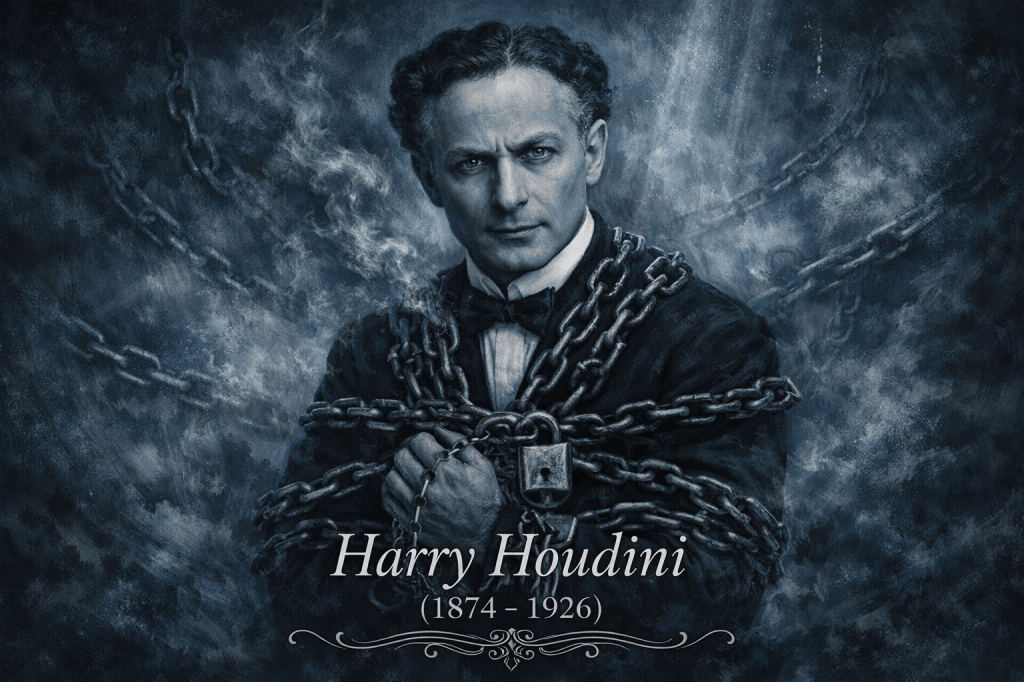
March 24, 1874
When a Proper Name Turned into an English Expression
Some people become famous.
A few become history.
But very rarely, a person becomes a word.
Born on March 24, 1874, Harry Houdini became the most famous escape artist in history, renowned for his seemingly impossible feats of illusion and confinement. Yet his greatest escape was perhaps not from chains or locked boxes, but from the limits of his own name. Over time, “Houdini” stopped referring only to a man and began to describe an action, an ability, a type of person.
He became shorthand for the impossible escape, the clever disappearance, the unexpected way out. In this way, Harry Houdini did not only leave a legacy in entertainment — he left one in language.
1. From Name to Expression: “To Pull a Houdini”
Houdini’s extraordinary reputation for escaping chains, locks, and sealed containers led his name to be used metaphorically in English.
Common uses include expressions such as “to pull a Houdini,” meaning to escape from a difficult situation cleverly, or describing someone as “a Houdini,” a person skilled at getting out of tight spots. Journalists, storytellers, and everyday speakers often refer to “Houdini-like escapes” when describing surprising disappearances or unlikely solutions.
These expressions show how a proper name can become linguistic shorthand for a specific kind of action — not just escaping, but escaping with ingenuity.
2. The Process of Eponym Formation in English
Houdini’s name is an example of an eponym — a word derived from a person’s name that enters common vocabulary.
This process happens when a person becomes so strongly associated with an idea, invention, behavior, or characteristic that their name begins to represent it. Over time, the name stops functioning only as a name and begins functioning as a word.
English contains many examples of this process: names that become verbs, idioms, or symbolic references. This transformation usually requires widespread cultural recognition, repeated use in media and storytelling, and a clear association between the person and a specific concept.
Houdini’s case demonstrates this process clearly: his name became synonymous with escape, ingenuity, and the ability to find a way out where none seemed possible.
3. Influence on Narrative and Journalistic Language
Because of his fame, Houdini became a reference point in storytelling, journalism, and everyday description.
His name appears in headlines describing dramatic escapes or disappearances, in sports and political commentary describing surprising reversals, and in fiction, where characters inspired by escape artists are often described as “Houdini-like.”
In these contexts, the name no longer refers directly to the historical person, but to an idea — the idea of escape against the odds.
This is how language transforms a person into a symbol.
4. A Lasting Example of Language Shaped by Popular Culture
Houdini’s linguistic legacy reflects the broader relationship between popular culture and vocabulary development in English.
Language does not grow only through grammar books and dictionaries; it grows through stories, newspapers, performances, and shared cultural references. When a figure becomes widely known, their name can enter the language as a metaphor, a verb, or a descriptive expression.
More than a century after his lifetime, Houdini’s name is still used in this way — a lasting example of how language absorbs history and turns people into symbols that continue to live in everyday speech.
Why It Matters
Harry Houdini’s birth in 1874 marks the arrival of a performer whose influence extended far beyond the stage. Through his legendary escapes, he became a cultural symbol — and ultimately, a linguistic one.
Not everyone leaves their name in a dictionary. But when a name becomes a word, it means a life has turned into a story, and the story has turned into a symbol.
And in that way, Harry Houdini never really disappeared.
He escaped chains—and then escaped into the language itself.
History shows when language changed.
At The English Nook, we explore how and why.
 What Happened on This Day?
Leave a comment