
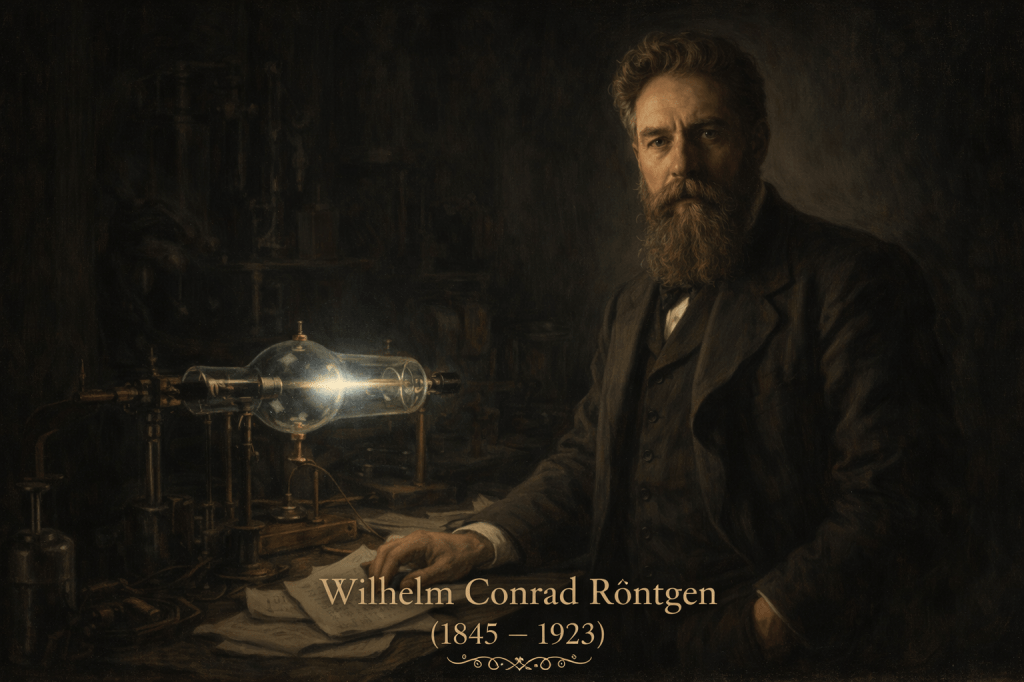
March 27, 1845
When Invisible Radiation Entered Both Science and Everyday English
Born on March 27, 1845, Wilhelm Conrad Röntgen became one of the most influential physicists of the modern era through his discovery of X-rays in 1895. Although his work originated in Germany, it was rapidly disseminated through the international scientific community—especially in English. The term “X-ray”, coined to describe this unknown form of radiation, quickly entered global usage, becoming one of the most recognizable examples of how scientific discovery directly expands the English vocabulary.
1. Introducing “X-ray” into Global English
Röntgen used the letter “X” to signify something unknown, creating the term X-ray, which was adopted almost immediately across languages, including English.
Key linguistic outcomes:
- “X-ray” became a standard scientific and medical term
- rapid transition from technical jargon to common everyday vocabulary
- use as both a noun and verb (“to X-ray something”)
- global standardization of the term in English-language science
- widespread public familiarity due to medical applications
Few scientific terms have entered everyday speech so quickly and universally.
2. Expanding Medical and Scientific Vocabulary
The discovery of X-rays opened entirely new fields in medicine and physics, requiring new terminology in English to describe techniques, tools, and phenomena.
Vocabulary influenced or reinforced includes:
- radiography
- radiation
- imaging
- diagnostic scanning
- electromagnetic waves
These terms became central to both professional and public discussions of health and science.
3. Demonstrating How Science Drives Lexical Innovation
Röntgen’s discovery is a clear example of how breakthroughs in science generate new words and meanings in English.
Key linguistic patterns illustrated:
- creation of terms based on unknown or abstract phenomena
- rapid adoption through scientific publication and translation
- movement from specialist language into general usage
- standardization of terminology across international communities
- influence of scientific naming conventions on everyday language
This process continues to shape modern English as new discoveries emerge.
4. A Lasting Presence in Both Technical and Everyday Language
More than a century later, the language associated with Röntgen’s discovery remains deeply embedded in English.
Long-term impact:
- continued use of “X-ray” in medicine, science, and metaphor
- influence on later terminology in imaging technologies (e.g., CT scans)
- symbolic use of “X-ray vision” in popular culture and fiction
- reinforcement of English as a global language of science
- demonstration of the close link between discovery and language growth
His contribution shows how a single term can bridge scientific and everyday communication.
Why It Matters
Wilhelm Conrad Röntgen’s birth in 1845 marks the arrival of a scientist whose discovery transformed both medicine and language. The term “X-ray” stands as a powerful example of how English evolves in response to new knowledge.
Through this and related vocabulary, Röntgen’s legacy lives on—not only in laboratories and hospitals, but in the everyday words people use to describe the unseen.
He revealed the unseen—and gave it a name.
 What Happened on This Day?
Leave a comment