
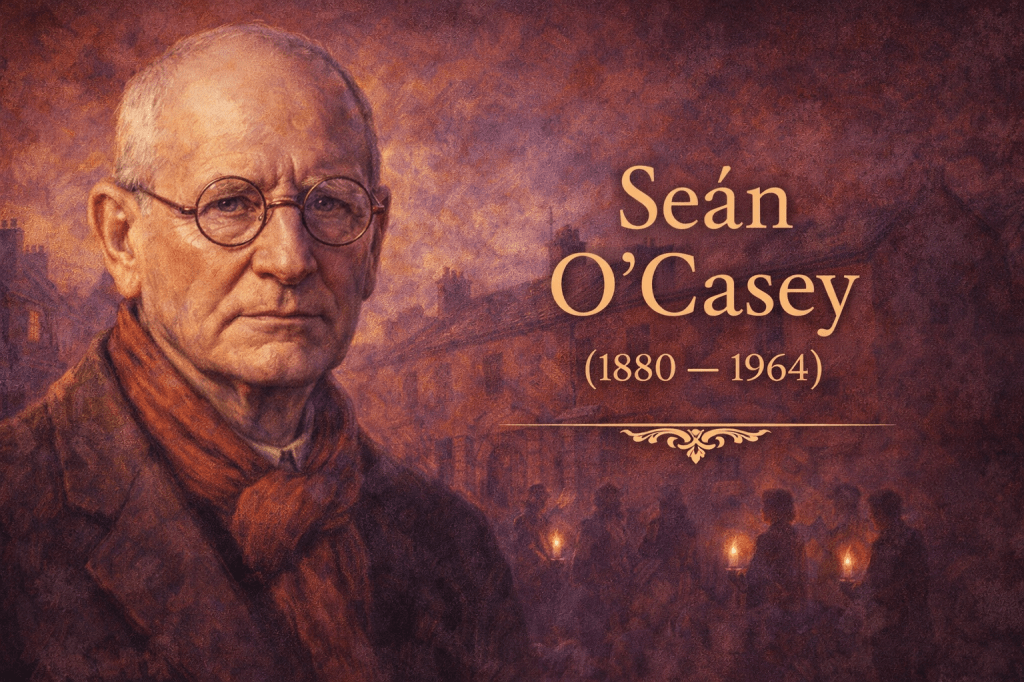
March 30, 1880
When Working-Class English Became the Voice of Modern Drama
Born on March 30, 1880, Seán O’Casey emerged as one of the most important playwrights of twentieth-century theatre. Writing about the lives of ordinary people in Dublin, he broke from more formal dramatic traditions by placing working-class speech at the center of his plays. Works such as Juno and the Paycock helped legitimize regional dialects in English drama, expanding both its linguistic range and emotional realism.
1. Elevating Dublin English to Literary Status
O’Casey’s plays are notable for their use of authentic Dublin speech, capturing the rhythms and vocabulary of everyday life.
Key linguistic contributions include:
- use of working-class dialect as the primary dramatic voice
- preservation of local idioms and expressions
- representation of spoken English with phonetic sensitivity
- movement away from standardized or “polished” stage language
- validation of regional speech as worthy of serious literature
This helped broaden what could be considered acceptable English in drama.
2. Expanding the Role of Dialect in English Theatre
By foregrounding regional speech, O’Casey influenced how playwrights approached language and character.
Important developments include:
- increased use of dialect for realism and characterization
- emphasis on language as a marker of social identity and class
- diversification of voices represented on stage
- challenge to dominant, upper-class linguistic norms
- encouragement of linguistic authenticity in performance
His work contributed to a more inclusive and varied dramatic English.
3. Blending Tragedy and Humor Through Language
O’Casey developed a distinctive tonal style, combining serious themes with moments of humor—often carried through dialogue.
Stylistic features include:
- juxtaposition of comic speech with tragic situations
- use of irony and wit rooted in everyday language
- naturalistic dialogue that shifts between lightness and intensity
- emotional depth conveyed through seemingly simple expressions
- creation of a uniquely modern dramatic voice
This balance influenced later playwrights in English-language theatre.
4. A Lasting Influence on Modern Dramatic English
O’Casey’s approach to language continues to shape theatre and writing more broadly.
Long-term impact:
- normalization of regional and working-class voices in drama
- influence on modern playwrights exploring social realism
- expansion of English as a language capable of reflecting diverse experiences
- contribution to the evolution of dialogue-driven storytelling
- enduring relevance in studies of language, class, and literature
His work helped redefine how English could sound on stage.
Why It Matters
Seán O’Casey’s birth in 1880 marks the arrival of a playwright who transformed the language of theatre. By bringing Dublin’s working-class speech into mainstream drama, he expanded the expressive possibilities of English.
In doing so, he helped create a more authentic, varied, and human dramatic language—one that continues to resonate in modern theatre.
He didn’t refine the stage—he made it speak real.
 What Happened on This Day?
Leave a comment