
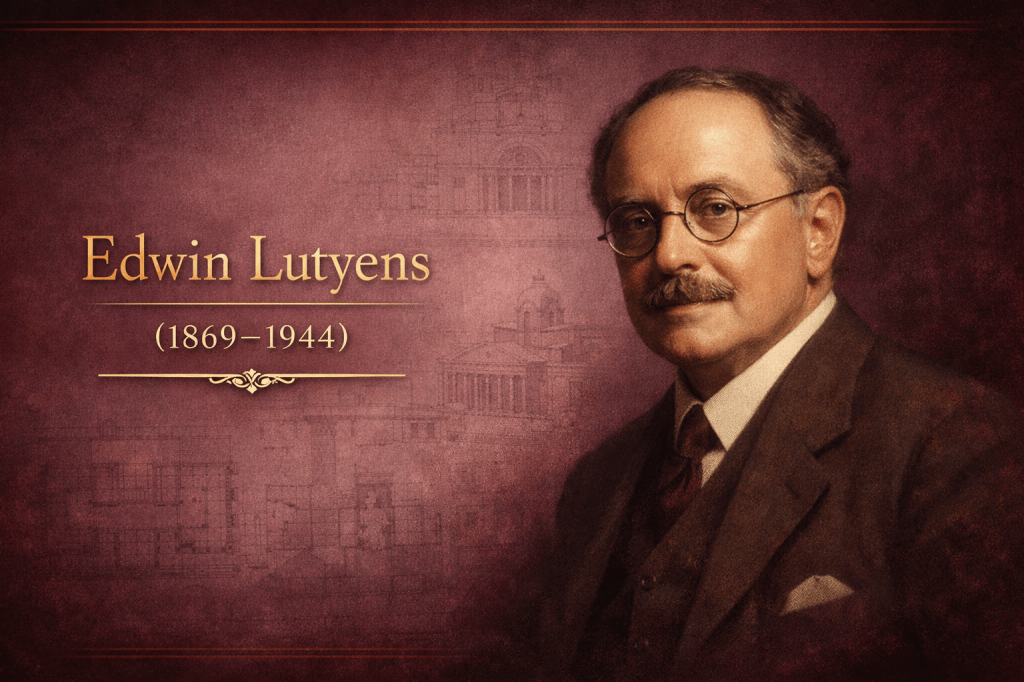
March 29, 1869
When Architecture and Correspondence Revealed the Tone of Elite British English
Born on March 29, 1869, Edwin Lutyens became one of Britain’s most influential architects, known for his role in designing imperial and civic spaces, including work in New Delhi. Alongside his architectural legacy, his letters and essays offer a valuable record of formal British English at the height of the British Empire. His writing reflects the tone, structure, and assumptions of elite communication during the late nineteenth and early twentieth centuries.
1. A Model of Formal British Written Style
Lutyens’s correspondence exemplifies the polished, controlled style associated with educated British elites of his time.
Key linguistic features include:
- formal tone with careful attention to propriety
- complex but balanced sentence structures
- precise vocabulary with subtle nuance
- restrained emotional expression
- adherence to conventions of polite written discourse
His writing reflects the standards expected in professional and social communication among the upper classes.
2. The Language of Empire and Administration
Working within the context of the British Empire, Lutyens’s writing also reflects the broader linguistic environment of imperial governance.
Notable characteristics of this context include:
- use of English as the language of administration and authority
- formal registers suited to official and bureaucratic communication
- vocabulary tied to planning, governance, and public works
- reinforcement of hierarchical relationships through language
- alignment of written English with institutional power
His correspondence illustrates how English functioned as a tool of coordination and control across imperial spaces.
3. Blending Technical and Personal Expression
As an architect, Lutyens frequently moved between technical description and personal reflection, enriching the expressive range of his English prose.
Linguistic features of this blend include:
- integration of architectural terminology into general writing
- clear explanation of complex design ideas
- shifts between professional and conversational tones
- use of metaphor and analogy to describe spatial concepts
- adaptability of English across technical and personal contexts
This flexibility demonstrates the versatility of English in specialized fields.
4. A Reflection of Cultural and Linguistic Standards of His Era
Lutyens’s writing provides insight into the broader norms that shaped elite English during a period of global influence.
Long-term linguistic significance:
- documentation of standard written British English at a historical peak
- influence on expectations of clarity and formality in professional writing
- contribution to the prestige associated with certain registers of English
- reflection of cultural values embedded in language use
- preservation of a style that continues to inform modern formal English
His work serves as a linguistic snapshot of a particular social and historical moment.
Why It Matters
Edwin Lutyens’s birth in 1869 marks the arrival of a figure whose influence extended beyond architecture into the realm of language. Through his letters and essays, he exemplified the formal, structured English of Britain’s imperial era.
His writing reveals how language, like architecture, can embody power, order, and cultural identity—offering a lasting record of how English was used at the highest levels of society.
He built with stone—but also with sentences.
 What Happened on This Day?
Leave a comment