
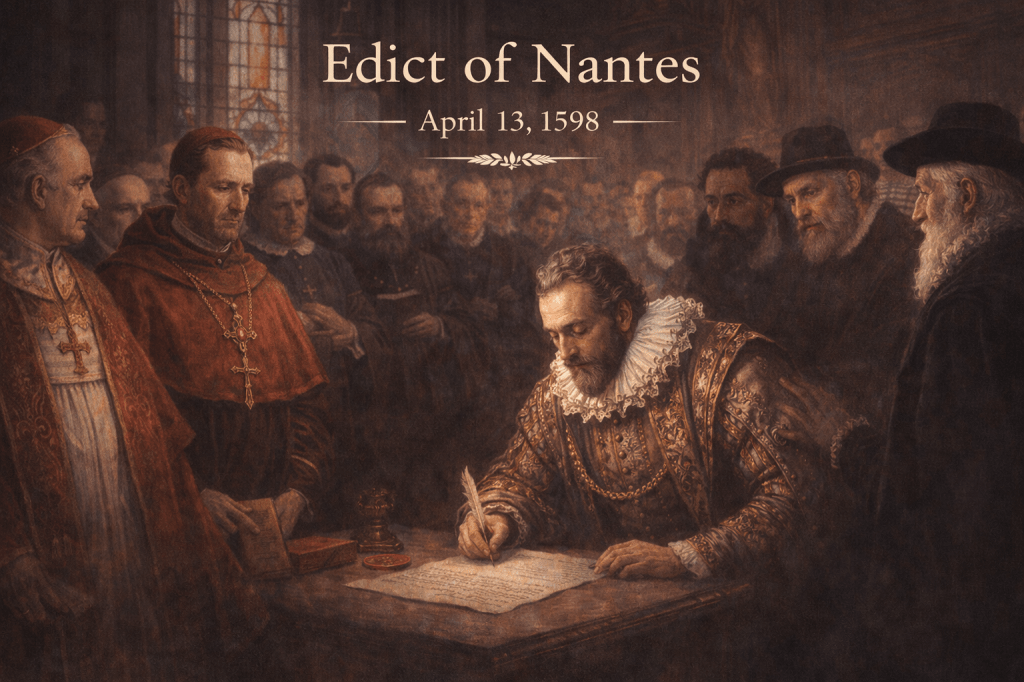
April 13, 1598
When Religious Tolerance Shaped European Discourse in English
On April 13, 1598, Henry IV of France issued the Edict of Nantes, granting a degree of religious tolerance to Protestants in a predominantly Catholic France. Although a French political act, its impact extended across Europe, influencing how religious conflict, tolerance, and governance were discussed in English. As the event was debated, translated, and analyzed, it contributed to the development of political and religious vocabulary in English discourse.
1. Expanding the Language of Religious Tolerance
The Edict introduced and popularized concepts that required new expression in English.
Key contributions include:
- increased use of terms related to tolerance and coexistence
- development of vocabulary around religious rights and protections
- refinement of language describing sectarian conflict
- emergence of more nuanced distinctions between belief and governance
- influence on discussions of religious plurality
English gained greater precision in addressing complex religious issues.
2. Influencing Political and Legal Vocabulary
As a formal royal decree, the Edict contributed to the language of governance and law.
Important developments include:
- use of terms related to edicts, rights, and legal protections
- expansion of political vocabulary through translation and commentary
- influence on discussions of state authority and individual rights
- shaping of legal language in English political writing
- contribution to early modern political discourse
The event helped enrich English as a language of law and governance.
3. Circulation Through Translation and Debate
The Edict became widely known beyond France through translation and commentary.
Key linguistic and cultural impacts include:
- transmission of French political ideas into English
- adaptation of foreign concepts into English terminology
- growth of pamphlets, essays, and debates in English
- influence on religious and political writers in England
- expansion of English as a language of international discourse
Translation played a key role in integrating these ideas into English.
4. Shaping the Language of Religious Conflict and Coexistence
The Edict became part of broader discussions about managing religious diversity.
Long-term impact:
- influence on later debates about tolerance and freedom of belief
- contribution to the vocabulary of coexistence and compromise
- shaping of how conflict and reconciliation are expressed in English
- integration into historical and political narratives
- role in the evolution of English discourse on rights and governance
Its legacy continued to inform how English addresses religious and political tensions.
Why It Matters
The issuance of the Edict of Nantes in 1598 marks a moment when ideas of tolerance and governance began to reshape European thought—and the English language used to express it. Through translation, debate, and analysis, English absorbed new ways of discussing rights, belief, and state power.
In doing so, English evolved into a more precise and flexible language for addressing some of society’s most complex and enduring questions.
When tolerance was declared, language learned to negotiate difference.
Also on this day!
If this moment still speaks, there is more to uncover.

 What Happened on This Day?
Leave a comment