
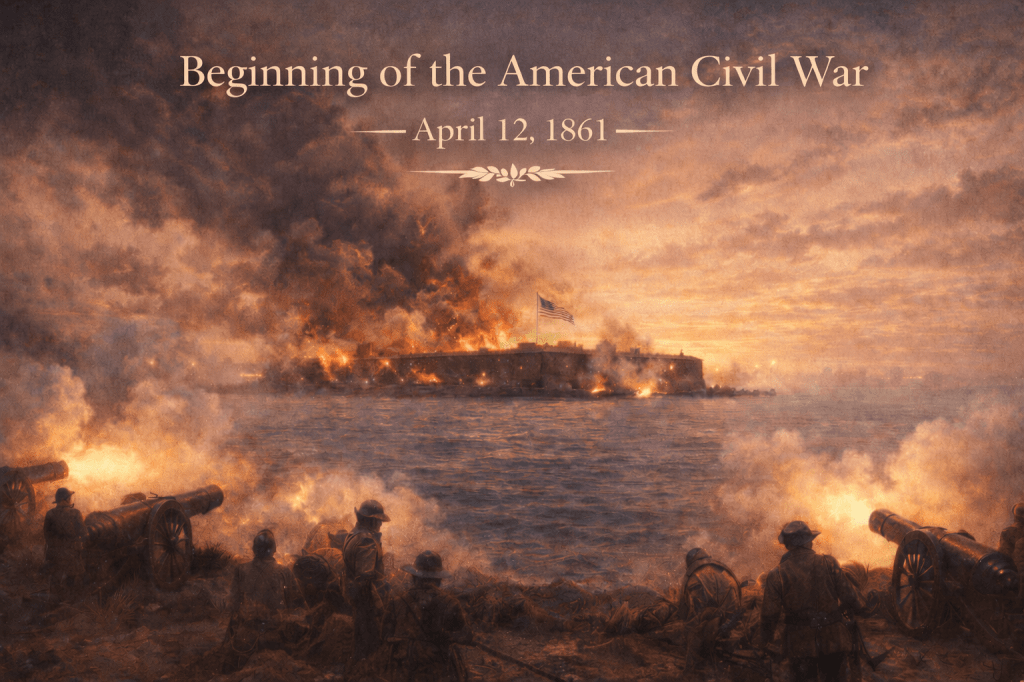
April 12, 1861
When War Reshaped the Language of a Nation
On April 12, 1861, the Battle of Fort Sumter marked the beginning of the American Civil War. As the United States entered a period of intense conflict, English became the primary medium through which the war was experienced, recorded, and understood. Through speeches, journalism, letters, and public debate, the war generated a vast body of language that helped shape the development of American English in lasting ways.
1. Expanding Public and Political Language
The war produced powerful speeches and public discourse that influenced English usage.
Key contributions include:
- rise of persuasive and rhetorical political speech
- increased use of emotionally charged and symbolic language
- development of vocabulary related to unity, division, and nationhood
- widespread circulation of speeches through print
- shaping of national identity through language
Public language became a central tool for influencing opinion and morale.
2. Growth of Journalism and Mass Communication
The Civil War accelerated the development of modern journalism in English.
Important developments include:
- expansion of newspaper reporting and war correspondence
- standardization of clear, concise reporting styles
- rapid dissemination of information to the public
- emergence of shared national narratives through print
- influence on the evolution of journalistic English
This period helped define how news would be written and consumed in English.
3. Everyday Language in Letters and Personal Accounts
Personal writing during the war contributed to the richness of American English.
Key linguistic and cultural impacts include:
- widespread use of letters as a primary form of communication
- documentation of everyday speech and expression
- preservation of regional dialects and voices
- blending of formal and informal language
- creation of a large archive of lived linguistic experience
These writings provide insight into how English was actually used by ordinary people.
4. Shaping Vocabulary and National Identity
The war introduced and popularized terms that became part of American English.
Long-term impact:
- expansion of military and political vocabulary
- development of terms related to conflict, strategy, and society
- influence on how Americans describe unity, freedom, and division
- integration of war-related language into everyday speech
- contribution to a shared linguistic identity
English became a vehicle for expressing both conflict and collective memory.
Why It Matters
The beginning of the American Civil War in 1861 marks a turning point in the history of American English. Through widespread communication—public, journalistic, and personal—the language evolved to reflect the realities of conflict and the struggle over national identity.
In this period, English became not only a means of communication, but a record of division, transformation, and the redefinition of a nation.
When war began, language became the voice of a nation in transformation.
Also on this day!
If this moment still speaks, there is more to uncover.
 What Happened on This Day?
Leave a comment