
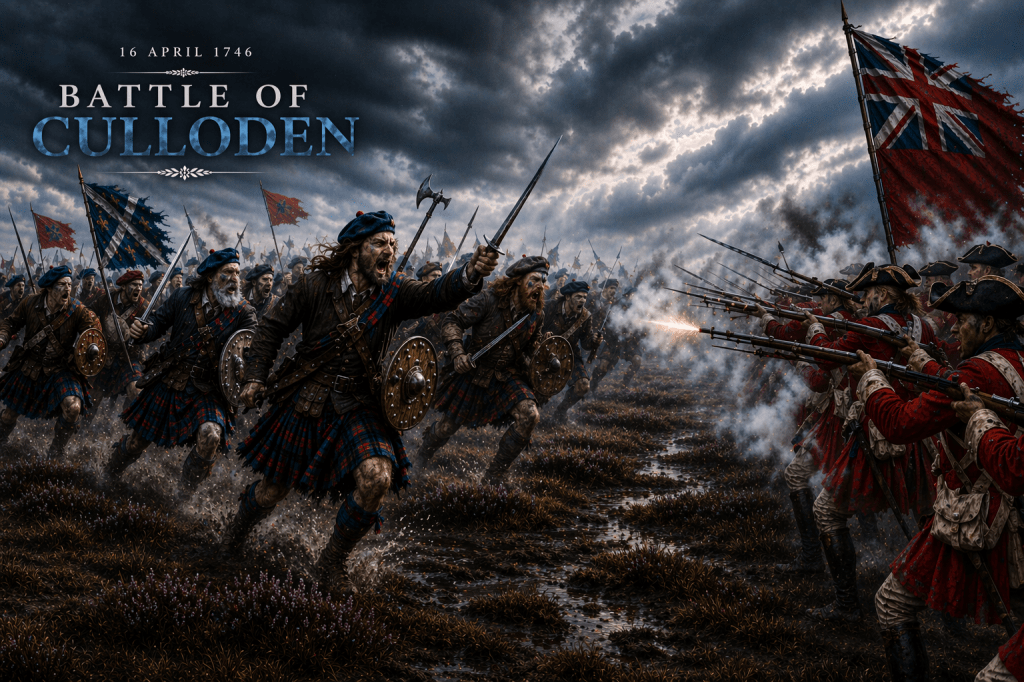
April 16, 1746
The Battle of Culloden and the Expansion of English
On April 16, 1746, the Battle of Culloden brought an end to the Jacobite rising in Scotland. It was brief, decisive, and brutal — the last pitched battle fought on British soil.
But its consequences did not end on the battlefield.
Culloden marked the beginning of a transformation that would unfold quietly over generations — not only in politics or culture, but in the very language people used to understand their world.
What followed was not just the defeat of an army.
It was the gradual displacement of a language.
1. Language and Power
In the aftermath of Culloden, the British government sought to dismantle the social structure of the Scottish Highlands. The clan system — deeply tied to identity, loyalty, and tradition — was systematically weakened.
With it came policies that reshaped daily life:
- restrictions on movement and assembly
- bans on traditional Highland dress
- increased military presence
- and the strengthening of centralized control
Within this environment, English began to assert itself more forcefully.
Not as a neutral tool —
but as the language of:
- authority
- law
- administration
- and economic opportunity
Gaelic, by contrast, became increasingly associated with:
- resistance
- marginalization
- and lack of access to power
Over time, the choice of language was no longer cultural.
It became practical.
2. When a Language Becomes Necessary
Language shifts rarely happen overnight.
After Culloden, Gaelic did not vanish immediately. It continued to be spoken in homes, communities, and oral traditions. But its position weakened as English became necessary for participation in the broader system.
To:
- deal with legal institutions
- access education
- engage in trade
- or interact with authorities
English was required
This created a gradual but powerful pressure:
Parents began encouraging children to learn English.
Communities adapted to survive within a new structure.
Over generations, bilingualism gave way to replacement.
This is one of the most important dynamics in linguistic history:
A language does not need to be banned to disappear.
It only needs to become less useful.
3. The Vocabulary of Control
As English spread, it carried with it a specific type of vocabulary — one tied to governance, order, and classification.
New words and concepts entered daily life:
- legal terms defining ownership and responsibility
- administrative language organizing land and people
- military terminology reinforcing hierarchy and command
- standardized expressions replacing local nuance
This was not just translation.
It was restructuring.
Gaelic had its own ways of expressing:
- relationships
- place
- belonging
- and identity
English introduced different frameworks — often more rigid, more formal, and aligned with centralized authority.
Language, in this sense, became a tool not only of communication, but of organization.
4. Cultural Loss and Linguistic Silence
As Gaelic declined, something less visible began to fade.
Languages carry more than words.
They carry memory.
Within Gaelic existed:
- oral storytelling traditions
- poetic forms tied to landscape and ancestry
- expressions that reflected a different relationship with time and place
Many of these did not transfer easily into English.
Translation can preserve meaning —
but it often loses:
- rhythm
- cultural reference
- emotional weight
Over time, entire ways of describing the world became quieter, then rarer, and eventually, absent.
This is the deeper cost of language loss:
Not just silence —
but the disappearance of perspective.
5. The Influence That Remained
And yet, languages rarely disappear without leaving traces.
Even as English became dominant, Gaelic continued to shape it in subtle ways:
- place names across Scotland (Inver-, Ben-, Glen-)
- loanwords and expressions that entered regional English
- intonation and rhythm influencing how English is spoken in certain areas
English did not simply replace Gaelic.
It absorbed parts of it — unevenly, imperfectly, but permanently.
This is how languages evolve:
through contact, conflict, and adaptation.
6. The Long View of Language Change
Culloden is not just a historical event.
It is a clear example of how language changes over time — not through grammar rules or dictionaries, but through human conditions:
- power determines which language is used publicly
- opportunity determines which language is taught
- survival determines which language is kept
English, as we know it today, is the result of countless moments like this.
Moments where one language expanded
as another receded.
Why It Matters
The Battle of Culloden shows that language is not separate from history.
It is shaped by:
- conflict
- policy
- identity
- and necessity
When we speak English today, we are not only using a system of words.
We are participating in a history —
one that includes growth, adaptation, and loss.
Sometimes, languages do not fade because they are forgotten.
Sometimes, they fade because the world around them changes.
Also on this day!
If this moment still speaks, there is more to uncover.
 What Happened on This Day?
Leave a comment