
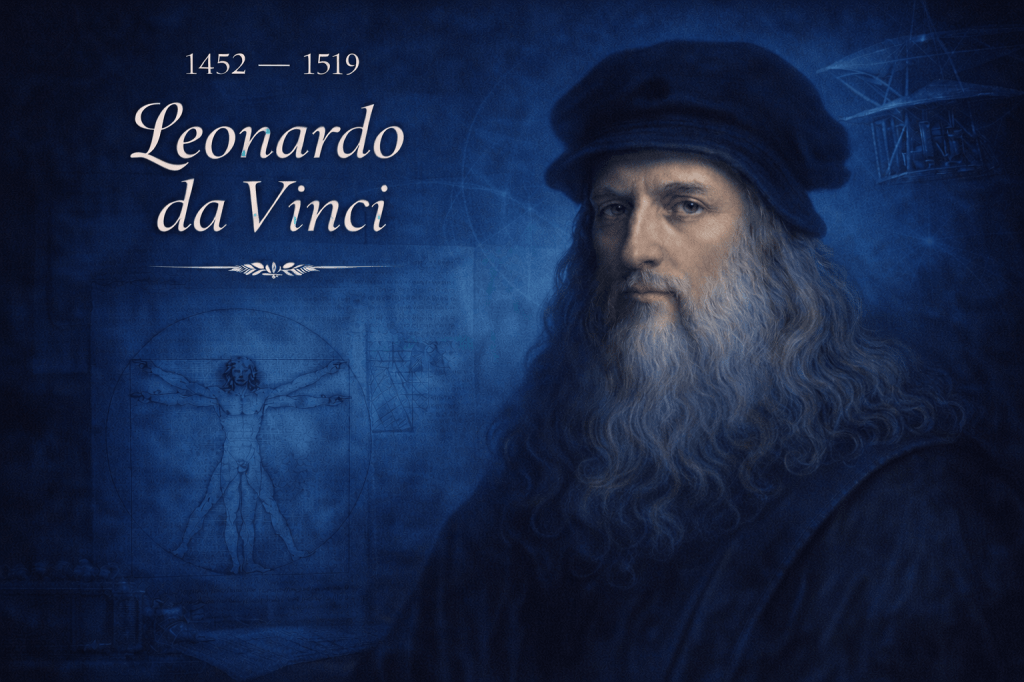
April 15, 1452
When Renaissance Thought Enriched English Through Translation and Influence
Born on April 15, 1452, Leonardo da Vinci was one of the most influential figures of the Renaissance, known for his work in art, science, and engineering. Although he wrote primarily in Italian, his notebooks and ideas were later studied, translated, and discussed in English, contributing to the expansion of descriptive, artistic, and scientific language. His legacy reflects a broader movement in which English absorbed and adapted knowledge from Renaissance Europe.
1. Expanding Descriptive Language in Art and Anatomy
Leonardo’s detailed observations influenced how visual and physical forms were described in English.
Key contributions include:
- development of precise terminology for anatomy and proportion
- influence on descriptive language in art and illustration
- refinement of vocabulary related to form, structure, and movement
- emphasis on observation as a basis for description
- expansion of English’s ability to capture visual detail
His work helped deepen the descriptive precision of English in both art and science.
2. Contributing to Scientific and Technical Vocabulary
Leonardo’s studies introduced concepts that later entered English through translation.
Important developments include:
- influence on terminology related to mechanics and engineering
- expansion of language describing motion, force, and design
- integration of interdisciplinary concepts into English vocabulary
- contribution to early scientific and technical discourse
- enrichment of English through Renaissance knowledge systems
His ideas helped broaden the conceptual range of English.
3. Bridging Art and Science in Language
Leonardo’s work blurred the boundaries between artistic and scientific expression.
Key linguistic and cultural impacts include:
- integration of artistic and scientific terminology
- development of language that connects observation with interpretation
- influence on interdisciplinary writing in English
- blending of visual imagination with analytical description
- contribution to a more holistic expressive framework
English benefited from this merging of ways of thinking and describing the world.
4. Influencing Intellectual and Descriptive Prose
Leonardo’s legacy shaped how knowledge could be expressed in writing.
Long-term impact:
- encouragement of detailed, observation-based prose
- influence on later scientific and artistic writers
- expansion of explanatory and analytical language
- contribution to clarity and depth in descriptive writing
- role in shaping intellectual discourse in English
His influence helped make English more capable of expressing complex ideas clearly.
Why It Matters
The birth of Leonardo da Vinci in 1452 marks the emergence of a figure whose ideas would later expand the expressive power of English. Through translation and intellectual influence, his work contributed to the development of more precise, descriptive, and interdisciplinary language.
In this way, English evolved into a language capable not only of describing the world—but of analyzing, visualizing, and reimagining it across art and science.
When art met science, language learned to see deeper.
Also on this day!
If this moment still speaks, there is more to uncover.

 What Happened on This Day?
Leave a comment