
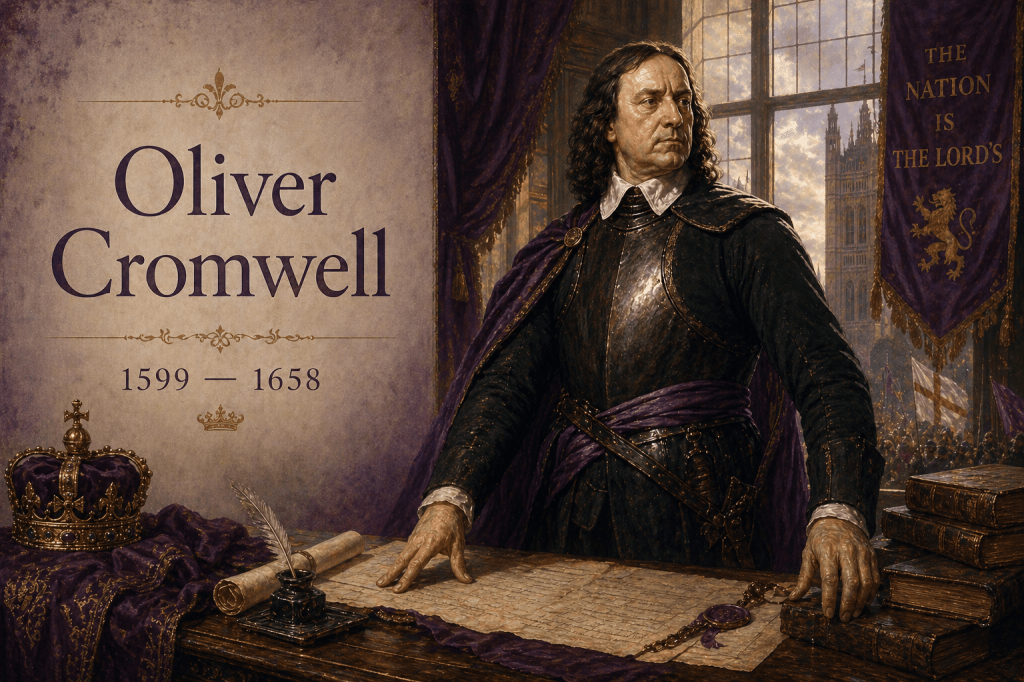
April 25, 1599
When Power Learned to Speak Plainly
Born on April 25, 1599, Oliver Cromwell emerged as one of the most consequential figures of 17th-century England. Soldier, parliamentarian, and later Lord Protector, he stood at the center of civil war, regicide, and the political experiment that followed the collapse of the monarchy.
His importance was not only military or constitutional. Cromwell belongs to the history of English because his age helped reshape how power was expressed in language. Under the pressures of war, religion, and revolution, English became more direct, more public, and more forcefully political.
English as the Language of Rule
By Cromwell’s time, English was no longer simply the language of common life. It had become the language of command.
Government, proclamation, administration, and political debate increasingly relied on English rather than the more distant authority of Latin or inherited ceremonial formality. The language of rule became plainer, more immediate, and more accessible to those it governed.
This marked an important shift: authority in England was no longer expressed only through tradition, but through language designed to be heard, understood, and obeyed.
The Power of Plain Speech
Cromwell’s rhetoric was rarely elegant, but it was effective. His speeches and letters often favored urgency over polish, conviction over ornament.
He spoke in a style that was direct, forceful, and often severe. This helped shape a form of political English that relied less on ceremony and more on pressure—language meant not to impress, but to compel.
In Cromwell’s hands, plain speech became an instrument of authority.
When Politics Spoke Like Religion
One of the defining features of Cromwell’s language is the way it fused political action with religious conviction.
His speeches often drew on biblical rhythms, moral certainty, and providential logic. Political decisions were framed not simply as matters of state, but as matters of divine necessity.
This gave English political language a new intensity. Power was no longer presented only as legal or hereditary. It could also be moral, spiritual, and justified through sacred language.
A New Language of Power
Cromwell’s England helped shape a vocabulary that would endure long after him: reform, authority, liberty, conscience, godliness, nation.
These were not new words, but under the pressures of the 17th century they acquired sharper political meaning. English became more capable of expressing revolution, legitimacy, and ideological conflict.
In this sense, Cromwell’s age did not simply change who ruled. It changed how rule could be spoken.
Why It Matters
The birth of Oliver Cromwell in 1599 marks a turning point in the history of political English. His era helped move English toward a more forceful public role—less ceremonial, more direct, and more capable of carrying the language of command.
Under Cromwell, English became not only a language of government, but a language of pressure, persuasion, and power.
Key Shifts in English Under Cromwell
- English as governance — political authority became more publicly expressed in English
- Plain rhetoric — direct speech gained force over ceremonial formality
- Political urgency — language became sharper, faster, and more persuasive
- Religious authority — biblical language entered political argument
- Moralized power — legitimacy was framed through faith as well as law
- Political vocabulary sharpened — English grew more capable of expressing revolution and rule
Some men change a nation by taking power.
Others change it by changing
the language power speaks.
Also on this day!
If this moment still speaks, there is more to uncover.

 What Happened on This Day?
Leave a comment