
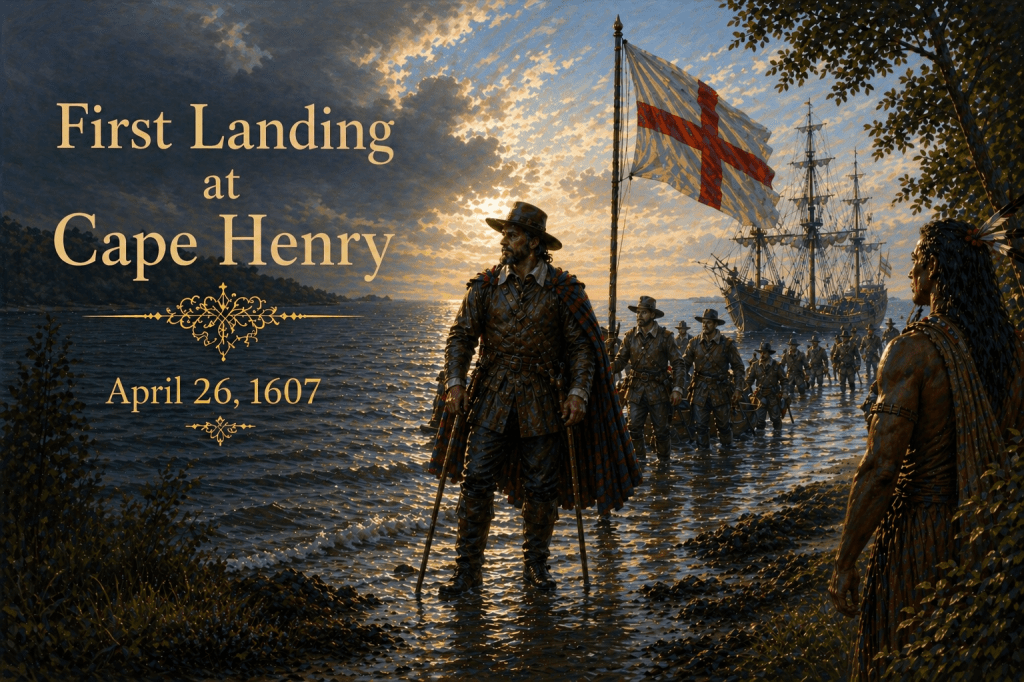
April 26, 1607
When English Crossed the Atlantic and Began to Change
On April 26, 1607, English settlers made their first landing at Cape Henry before moving inland to establish what would become the Virginia Colony. It was not yet a nation, nor even a stable settlement, but it marked something historically decisive: one of the first sustained arrivals of English on North American soil.
The language that crossed the Atlantic did not remain unchanged for long. Once removed from England and placed in a new landscape, English entered a different world—one that would gradually reshape how it sounded, what it described, and what it would become.
A Language in New Ground
Cape Henry marks one of the earliest moments when English began to exist outside its original geographic and cultural frame. What had once been tied to England alone now had to function elsewhere—in unfamiliar climates, new social conditions, and different physical realities.
This mattered because language does not travel untouched. Once English began to live in North America, it also began to adapt to it.
New Worlds, New Words
The English spoken by early settlers quickly encountered things it had no ready vocabulary for. Landscapes, plants, animals, and social structures often had no direct equivalent in England.
To compensate, English expanded. Some words were borrowed from Indigenous languages. Others were adapted from existing English terms and given new meanings. This is one of the earliest moments in which English begins to stretch beyond its European frame and absorb the realities of another world.
What changed first was not grammar, but reference.
Distance Creates Difference
Geography did more than separate speakers from England. It began to separate English from itself.
Distance, settlement patterns, and local adaptation slowly produced differences in pronunciation, vocabulary, and usage. These changes were gradual, but they mattered. Over time, English in North America began to develop its own rhythms and habits—still recognizably English, but no longer entirely the same.
This is where divergence begins.
The Beginning of Another English
The long-term consequence of that first landing was not simply the spread of English, but the beginning of another form of it.
What would eventually become American English began here—not fully formed, but in motion. As the language adapted to new conditions, it became more flexible, more expansive, and increasingly distinct from the English it left behind.
Cape Henry marks one of the earliest moments in that transformation.
Why It Matters
The first landing at Cape Henry in 1607 represents more than a colonial beginning. It marks one of the first moments when English became a language in migration.
Once English crossed the Atlantic, it stopped being shaped by England alone. It entered new environments, absorbed new influences, and began the long process of becoming something larger, more adaptive, and eventually more global.
Key Shifts in English After Cape Henry
- Geographic separation — English began developing outside England
- Environmental adaptation — the language adjusted to unfamiliar landscapes and realities
- Vocabulary expansion — new words emerged through contact and necessity
- Cross-cultural influence — Indigenous contact shaped reference and expression
- Dialect formation — regional variation began to emerge
- Early divergence — English in North America started becoming something distinct
Sometimes, a language changes not when it is rewritten—
but when it is carried somewhere new and asked to begin again.
Also on this day!
If this moment still speaks, there is more to uncover.


 What Happened on This Day?
Leave a comment