
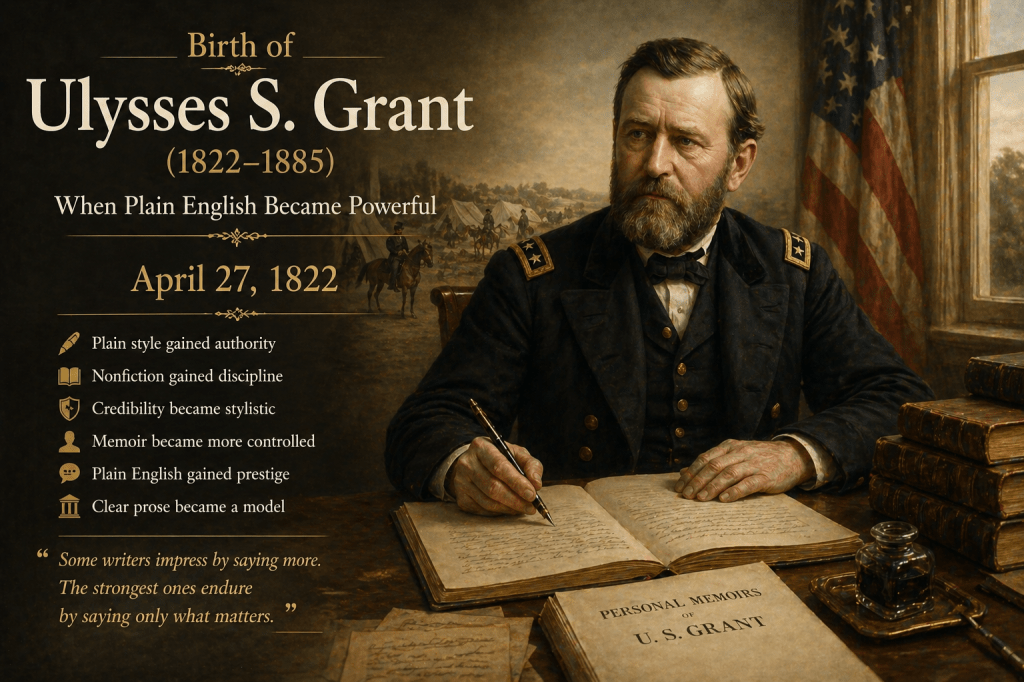
April 27, 1822
When Clarity Became a Literary Strength
Born on April 27, 1822, Ulysses S. Grant is most often remembered as a Union general and later as President of the United States. Yet one of his most enduring contributions to English lies not in politics or war, but in prose.
His Personal Memoirs remain one of the clearest examples of effective nonfiction writing in English. Written late in life and under extraordinary pressure, they show how restraint, precision, and clarity can carry more force than ornament ever could.
The Strength of Plain Style
Grant’s prose is notable for what it refuses to do. It does not decorate, dramatize, or overstate.
His sentences are direct, measured, and unadorned. He writes with a calm confidence that privileges clarity over display, allowing events to carry their own weight. The effect is not plainness as limitation, but plainness as control.
In Grant’s hands, English proves that authority does not require flourish.
Writing History Without Excess
One of the lasting strengths of Grant’s memoirs is their balance between personal memory and historical record.
He writes as both participant and witness, moving steadily through events without surrendering to self-mythology. The tone remains controlled, even when the subject is war. Reflection is present, but never indulgent.
This helped shape a model of nonfiction in which narrative remains readable, reliable, and disciplined.
The Credibility of Clear English
Grant’s style carries a quality often associated with good prose but rarely achieved so cleanly: trust.
His language feels credible because it avoids performance. It narrows the distance between writer and reader, not through intimacy, but through precision. He states what happened, why it mattered, and moves forward.
That clarity gives the prose its authority. In Grant’s writing, plain English becomes persuasive not because it is simple, but because it is exact.
A Lasting Standard for Nonfiction
Grant’s memoirs became more than a historical account. They became a model.
Writers, teachers, historians, and public figures have long pointed to his prose as an example of what English can do at its most effective: remain clear under pressure, structured without stiffness, and powerful without excess.
His legacy is not only what he wrote about, but how he wrote it.
Why It Matters
The birth of Ulysses S. Grant in 1822 marks the emergence of a writer who demonstrated one of the most durable strengths in English: clarity.
His prose showed that language does not need ornament to carry weight. In the right hands, directness becomes authority, restraint becomes style, and plain English becomes powerful.
Key Shifts in English Through Grant
- Plain style gained authority — clarity proved stronger than ornament
- Nonfiction gained discipline — narrative and record were held in balance
- Credibility became stylistic — trust emerged through precision
- Memoir became more controlled — personal narrative grew steadier and less performative
- Plain English gained prestige — simplicity became a literary strength
- Clear prose became a model — Grant helped define effective nonfiction in English
Some writers impress by saying more.
The strongest ones endure
by saying only what matters.
Also on this day!
If this moment still speaks, there is more to uncover.


 What Happened on This Day?
Leave a comment