
May 13, 2024
When Small Narratives Became Vast
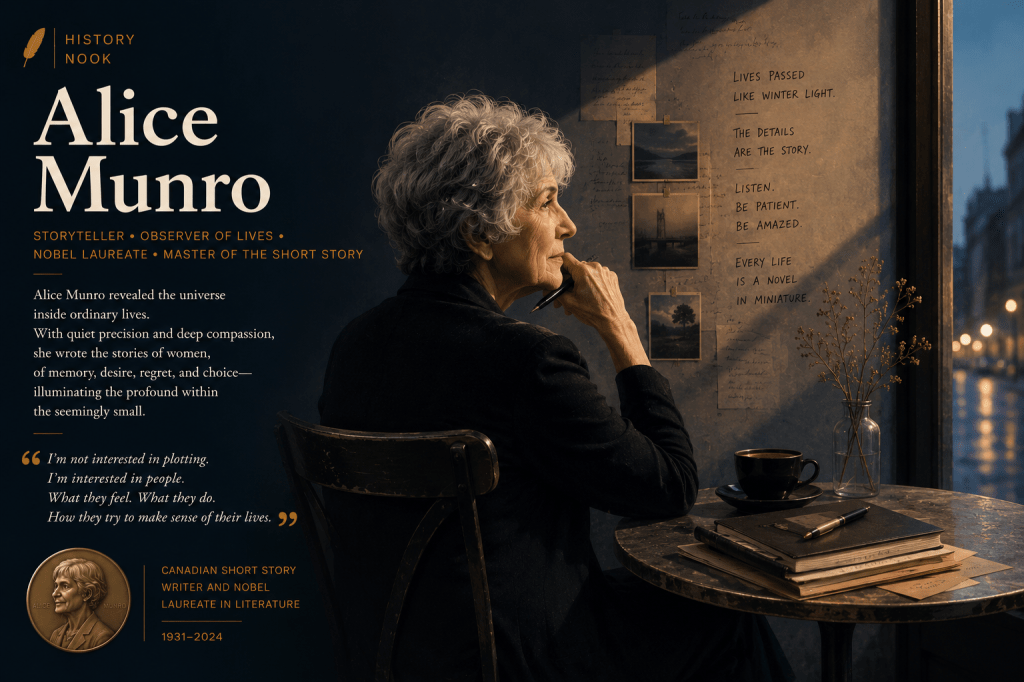
On May 13, 2024, Alice Munro died at the age of 92, leaving behind one of the most influential bodies of short fiction in modern English literature. Awarded the Nobel Prize in Literature in 2013, she was recognized as a “master of the contemporary short story”—a description that captures not only her achievement, but the transformation she helped bring to the form itself.
Munro demonstrated that short fiction did not need to sacrifice complexity for brevity. Through precision, psychological subtlety, and extraordinary structural control, she helped make the short story one of the most powerful forms in modern English prose.
Precision Without Excess
Munro’s prose is often deceptively simple.
Her sentences rarely call attention to themselves, yet they are meticulously controlled. Emotion emerges through observation rather than declaration, and meaning accumulates through detail, silence, and implication. She avoided dramatic excess without losing emotional force.
In Munro’s work, restraint becomes intensity.
Expanding the Architecture of the Short Story
One of Munro’s greatest innovations lies in structure.
Her stories move fluidly across decades, memories, relationships, and emotional shifts while remaining remarkably clear. Time in her fiction behaves less like a straight line and more like layered consciousness—folding backward and forward without confusion.
She transformed the short story from a compact anecdote into something capable of carrying the weight and complexity of a novel.
Making Ordinary Lives Profound
Munro also helped redefine literary realism in English.
Her fiction often centers on ordinary lives, domestic spaces, quiet decisions, and emotional undercurrents that might seem minor at first glance. Yet through precision and psychological depth, these moments acquire extraordinary significance.
She showed that English prose did not need spectacle to reveal the complexity of human experience.
A Global Influence on Literary English
Munro’s influence extended across the English-speaking world and far beyond it.
Writers in Canada, Britain, the United States, and elsewhere absorbed her approach to narrative control, emotional subtlety, and compressed storytelling. Her work strengthened expectations that literary prose could remain restrained while still achieving immense depth.
She helped redefine what modern English fiction sounds like at its quietest and most exact.
Why It Matters
The death of Alice Munro in 2024 marks the passing of a writer who permanently transformed modern English prose.
Through precision, compression, and psychological realism, she proved that the smallest narrative forms could contain the full complexity of human life.
She helped make the English short story not a lesser form of literature—but one of its highest achievements.
Key Shifts in English Through Munro
- Short fiction gained prestige — the short story became a major literary form
- Precision deepened realism — restraint carried emotional power
- Narrative structure expanded — time and memory moved more fluidly in prose
- Ordinary life gained literary depth — subtle experience became central to fiction
- Compression became complexity — brevity carried novel-like weight
- Modern literary English grew quieter and sharper — subtlety became a defining strength
Some writers make stories larger.
Alice Munro showed how much of life
can fit inside a few pages.
Also on this day!
If this moment still speaks, there is more to uncover.

 What Happened on This Day?
Leave a comment