
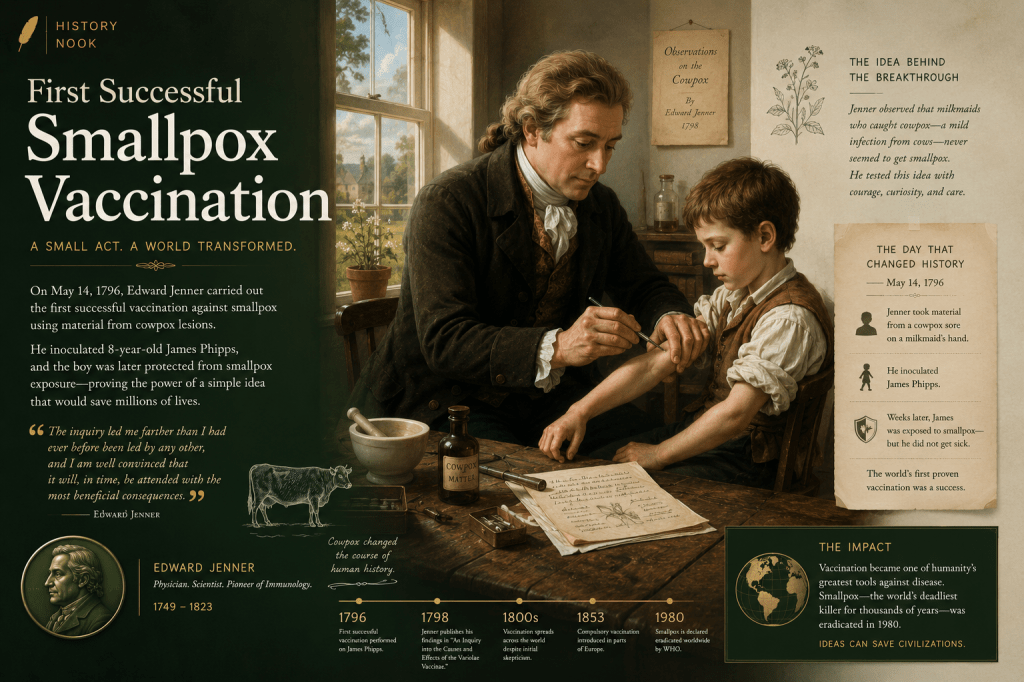
May 14, 1796
When Medicine Changed the Vocabulary of the Future
On May 14, 1796, Edward Jenner performed the first successful smallpox vaccination, using material from cowpox to protect against one of the deadliest diseases in human history.
The event transformed medicine—but it also transformed language. From this moment onward, English acquired a new vocabulary for protection, immunity, and prevention. Words such as vaccine, vaccination, immunization, and inoculation would become central not only to medicine, but to public life itself.
English gained new ways to speak about health before illness arrived.
Creating the Language of Vaccination
Jenner’s discovery introduced one of the most influential word families in modern English.
The term vaccination derives from the Latin vacca, meaning “cow,” referencing the use of cowpox in Jenner’s method. Over time, the word expanded beyond its original context and became a universal term for preventive immunization.
This marked an important linguistic shift: medicine increasingly developed vocabulary not only for curing disease, but for preventing it.
Changing How Public Health Was Discussed
Vaccination altered more than scientific terminology. It changed public discourse.
As immunization practices spread, English absorbed a broader language of public health: immunity, prevention, contagion, epidemic control, and collective safety. Medical discussion moved increasingly toward population-level thinking rather than isolated treatment.
Public health became not only a scientific system, but a linguistic framework through which societies discussed responsibility, risk, and protection.
Making Medical English More Public
Jenner’s work also strengthened explanatory medical prose.
Scientific writing increasingly needed to communicate with governments, communities, and ordinary readers—not only physicians. Observation, evidence, procedure, and persuasion became more central to medical English as vaccination campaigns expanded.
Medicine required language capable not only of describing science, but of building trust in it.
A Vocabulary That Crossed the World
The words associated with vaccination spread internationally alongside modern medicine.
Terms born from Jenner’s work entered legal systems, schools, government policy, journalism, and global scientific communication. Few medical concepts have become so universally recognizable across languages and cultures.
In this sense, vaccination changed English not only internally, but globally.
Why It Matters
The first successful smallpox vaccination in 1796 marks a turning point not only in medicine, but in the history of English.
By introducing new concepts of immunity, prevention, and collective protection, Jenner helped create some of the most important public-health vocabulary in the modern world.
He helped make English not only a language for describing illness—but a language for preventing it.
Key Shifts in English Through Vaccination
- Medical vocabulary expanded — vaccination and immunity entered common usage
- Prevention gained linguistic importance — medicine shifted beyond treatment alone
- Public-health language strengthened — epidemic control and safety gained clearer terminology
- Medical prose became more explanatory — science increasingly addressed the public directly
- Scientific trust entered language — persuasion became part of medical communication
- English medical terminology spread globally — vaccination vocabulary became internationally recognized
Some discoveries save lives.
Others also change
the words societies use to protect themselves.
Also on this day!
If this moment still speaks, there is more to uncover.

 What Happened on This Day?
Leave a comment