
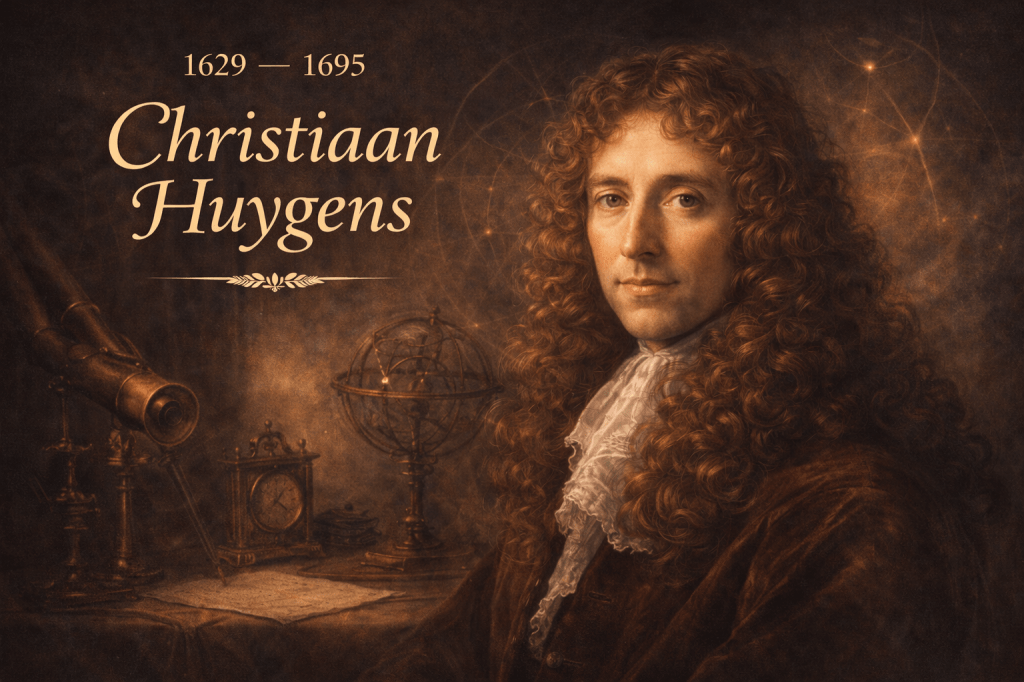
April 14, 1629
When Scientific Thought Crossed Languages into English
Born on April 14, 1629, Christiaan Huygens was a leading figure in early modern science, known for his work in physics, astronomy, and mathematics. Although he wrote primarily in Latin and French, his ideas were later translated into English, contributing to the expansion of scientific knowledge within the language. His work reflects a period in which English was increasingly absorbing and adapting scientific concepts from across Europe.
1. Expanding Technical Vocabulary in English
The translation of Huygens’ work introduced and reinforced specialized terminology.
Key contributions include:
- incorporation of scientific terms related to physics and astronomy
- refinement of vocabulary describing motion, light, and mechanics
- expansion of precise, technical language in English
- adaptation of European scientific terminology into English usage
- contribution to the growing lexicon of scientific discourse
His work helped support the increasing precision of English in scientific contexts.
2. Supporting the Development of Scientific Discourse
Huygens’ writings influenced how scientific ideas were communicated in English.
Important developments include:
- emphasis on clarity and logical structure in scientific explanation
- use of systematic observation and reasoning in writing
- influence on the organization of scientific arguments
- contribution to a more formalized scientific prose style
- alignment with emerging standards in scientific communication
His approach reinforced the clarity and rigor expected in English scientific writing.
3. Part of the European Knowledge Exchange into English
Huygens was part of a broader network of scholars whose work circulated across languages.
Key linguistic and cultural impacts include:
- transmission of ideas through translation into English
- integration of continental scientific advances into English discourse
- strengthening of English as a language of international scholarship
- interaction between Latin, French, and English scientific traditions
- expansion of English through intellectual exchange
English evolved by absorbing knowledge from multiple linguistic sources.
4. Contributing to the Rise of English in Science
Huygens’ influence coincided with a shift toward English as a scientific language.
Long-term impact:
- support for the transition from Latin to vernacular scientific writing
- contribution to the growth of English as a language of science
- influence on later scientists writing in English
- expansion of technical and academic expression
- role in shaping modern scientific communication
His work forms part of the foundation of scientific English as we know it today.
Why It Matters
The birth of Christiaan Huygens in 1629 represents a moment in the broader transformation of English into a language of science. Through translation and intellectual exchange, his ideas contributed to the expansion of technical vocabulary and the refinement of scientific discourse.
In this process, English grew from a regional language into a powerful medium for describing, analyzing, and sharing knowledge about the natural world.
When ideas crossed languages, English learned to speak science.
Also on this day!
If this moment still speaks, there is more to uncover.

 What Happened on This Day?
Leave a comment