
October 24, 1945
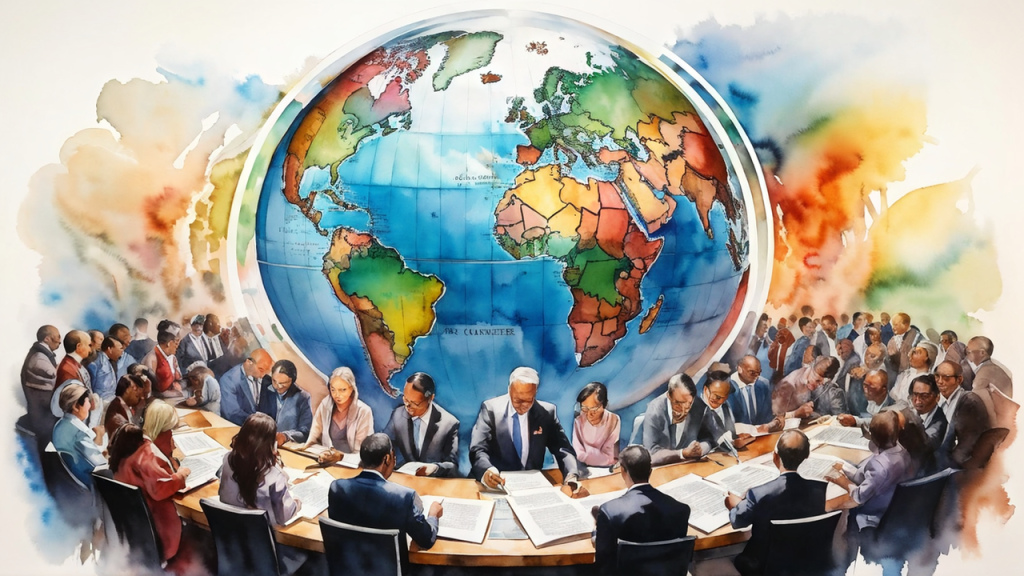
On October 24, 1945, the United Nations (UN) was officially established in the aftermath of World War II, marking a new era in global governance and international diplomacy. Its creation introduced a wealth of new terminology into the English language, reflecting the organization’s mission to promote peace, security, and cooperation among nations. As the UN grew in prominence, many of the terms and concepts it fostered became integral to political discourse, shaping how English speakers talked about international relations, diplomacy, and human rights. This transformation of the political lexicon continues to influence English today, as the UN plays a central role in global politics and conflict resolution.
Key Terms Introduced by the United Nations
The formation of the UN brought a range of terms into broader use, many of which are now essential in discussions of global governance and international relations. These words captured the ideals and operational principles of the organization, reflecting its multifaceted approach to solving global issues.
- “Peacekeeping” is one of the most iconic terms associated with the UN, referring to the efforts of international forces to maintain peace and security in conflict zones. This term gained widespread usage as the UN deployed peacekeeping missions in regions torn apart by war or civil strife. “Peacekeeping” evolved to symbolize not just military intervention, but also diplomatic efforts to broker ceasefires and support post-conflict recovery. The term remains central to discussions about conflict resolution and international intervention.
- “Multilateralism” refers to the UN’s core principle of cooperation among multiple nations to achieve common goals. The concept of multilateralism, contrasting with unilateral or bilateral actions, gained prominence through the establishment of the UN, where countries work together within a global framework to address issues such as peace, security, development, and environmental sustainability. This term is now widely used in international diplomacy and political discourse to describe the importance of collaboration among nations in tackling global challenges.
- “Human rights” also emerged as a key term following the formation of the UN. The adoption of the Universal Declaration of Human Rights in 1948, just three years after the UN’s founding, solidified this phrase in the English language. The document outlined the fundamental rights and freedoms to which all people are entitled, giving rise to a vocabulary focused on civil liberties, individual rights, and social justice. Today, terms like “human rights abuses,” “rights-based approaches,” and “universal human rights” are central to legal and political discussions.
- “International diplomacy” refers to the negotiation and management of relationships between countries. Although diplomacy existed long before the UN, the creation of this international body heightened the importance of diplomacy on a global scale, promoting peaceful resolutions to conflicts through dialogue and cooperation. As the UN took on a more central role in mediating disputes and fostering communication between nations, the term “international diplomacy” gained greater relevance in the English lexicon.
Expansion of the Political and Diplomatic Lexicon
The establishment of the United Nations also led to the expansion of terms related to governance, conflict resolution, and humanitarian aid, which became critical components of the political and diplomatic vocabulary in the latter half of the 20th century.
- “Global governance” is a term that reflects the UN’s role in managing international affairs. While the UN is not a world government, its influence over issues like peacekeeping, international law, climate change, and global health made “global governance” a key phrase to describe the way international institutions work to coordinate responses to cross-border challenges. This concept is now fundamental to discussions about how nations collaborate to solve issues that transcend national boundaries.
- “Sustainable development” is another phrase that gained prominence through the UN’s efforts to promote long-term economic growth that meets present needs without compromising future generations. The introduction of the Sustainable Development Goals (SDGs) in 2015 cemented this concept in global discourse, as these goals outlined specific targets to tackle issues like poverty, inequality, and environmental degradation. The term “sustainability” has since become a common part of the English language, expanding beyond environmental discussions to cover areas like business, architecture, and agriculture.
- “Humanitarian intervention” emerged from the UN’s responsibility to respond to crises where human rights are violated on a massive scale, such as in cases of genocide, famine, or war crimes. The UN’s role in coordinating international responses to such crises helped popularize this term in English, along with related phrases like “humanitarian aid” and “humanitarian crisis.” The vocabulary of humanitarian work has grown as global awareness of issues like refugees, displacement, and post-conflict recovery has increased.
- “Sanctions” and “embargoes” are terms that became widely associated with the UN’s role in enforcing international law and responding to acts of aggression or human rights violations. The UN’s Security Council often imposes sanctions as a tool of diplomacy, whether to pressure governments or individuals. As a result, terms like “economic sanctions” and “trade embargo” became more frequent in discussions about international relations, law, and justice.
Shaping the Language of Global Politics
The creation of the UN also popularized terms and phrases related to broader political ideas, many of which became essential in discussions of international law and diplomacy.
- “Collective security” is a concept that encapsulates the UN’s approach to maintaining peace, whereby nations agree to act together in response to threats to international peace and security. This idea formed the basis for the UN’s peacekeeping missions and resolutions, and the term entered common usage in English, especially during discussions about alliances like NATO and the role of international organizations in preventing conflicts.
- “Sovereignty” and “self-determination” are two related terms that gained prominence in the post-World War II era, as the UN worked to decolonize large parts of Africa, Asia, and the Middle East. These terms were frequently used in discussions about the rights of nations and peoples to govern themselves without external interference. As more countries gained independence in the decades following the UN’s formation, these concepts became central to political discussions worldwide.
- “Conflict resolution” and “mediation” are terms that grew out of the UN’s mission to resolve disputes peacefully. The need for international dialogue and diplomacy to prevent war and violence gave rise to these phrases, which have since become common in discussions about both international relations and more local or interpersonal disputes.
The Role of the UN in Language Evolution
The UN’s influence on the English language reflects its broader impact on global politics and society. As the world’s premier international organization, the UN has been at the center of efforts to address the most pressing global issues, from wars and conflicts to environmental challenges and health crises. In the process, it has introduced new terms, shaped existing vocabulary, and popularized concepts that have enriched the English language.
For example, the concept of “peacebuilding”—which encompasses efforts to create long-term peace by addressing the root causes of conflict—emerged from the UN’s work in post-conflict regions. Similarly, the idea of “non-governmental organizations (NGOs)” gained currency as the UN partnered with civil society to address humanitarian crises and promote development.
As the UN expanded its focus to include environmental protection, health, and education, it also helped popularize terms like “climate change,” “pandemic preparedness,” and “gender equality,” all of which have become central to contemporary political discussions. In this way, the UN’s language has not only reflected its goals but also influenced the way people around the world talk about global issues.
The Lasting Legacy of the UN on Language and Diplomacy
The formation of the United Nations on October 24, 1945, was a turning point in global governance and diplomacy, bringing with it a host of new terms and concepts that have had a profound impact on the English language. From “peacekeeping” and “human rights” to “multilateralism” and “global governance,” the vocabulary introduced by the UN reflects its mission to promote peace, security, and cooperation among nations.
As the UN continues to play a central role in addressing the world’s challenges, its influence on the language of politics, diplomacy, and international relations remains significant. The terms and ideas introduced by the UN have not only enriched the English language but have also shaped how we understand and engage with the world today.
Originally published on October 24, 2024, on The-English-Nook.com.
 What Happened on This Day?
Leave a comment