
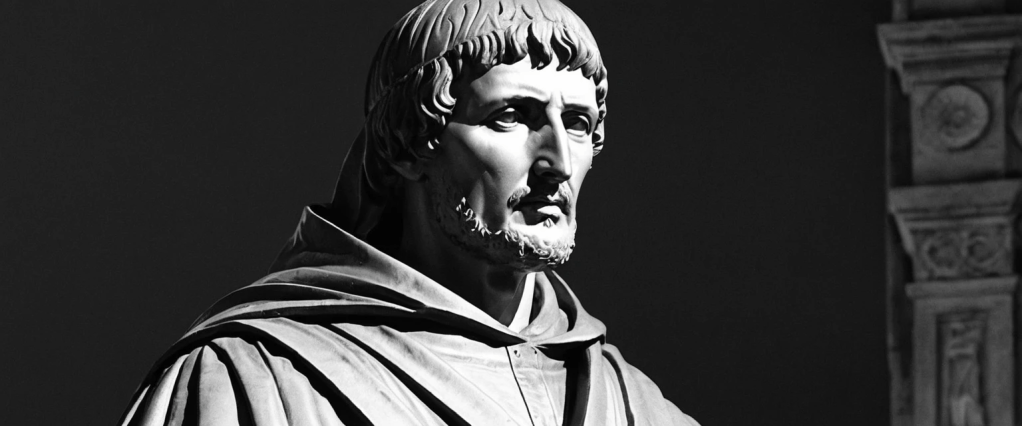
February 17, 1600
Martyr of Ideas and the Infinite Universe
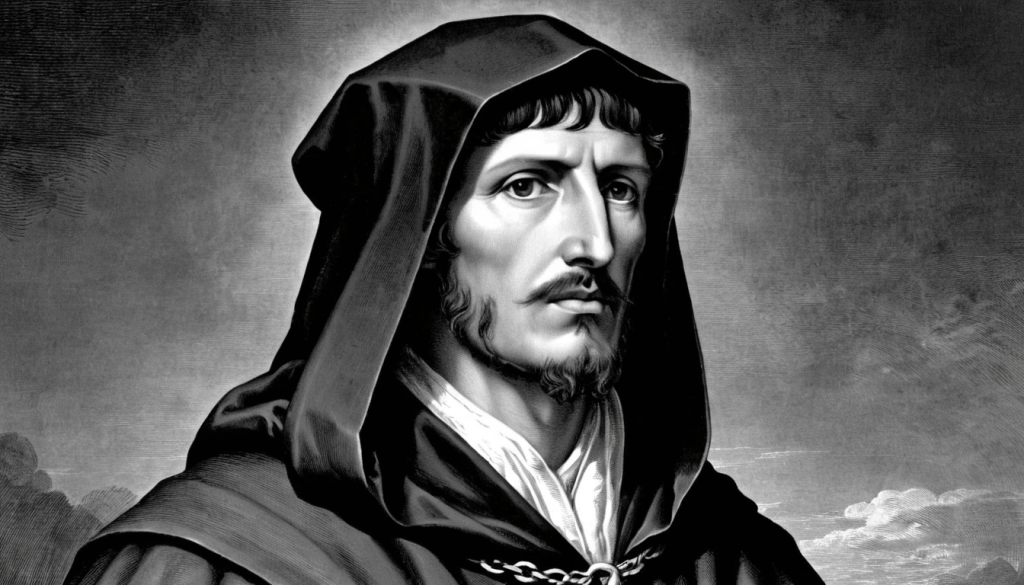
On February 17, 1600, Giordano Bruno, an Italian philosopher, mathematician, and former Dominican friar, was burned at the stake in Rome’s Campo de’ Fiori after being convicted of heresy by the Roman Inquisition. His radical theories, which included the belief in an infinite universe, the plurality of worlds, and the rejection of traditional religious dogma, challenged both Catholic doctrine and the prevailing Aristotelian-Ptolemaic worldview. Bruno’s execution became a turning point in intellectual history, symbolizing the conflict between dogma and scientific inquiry, and shaping English-language discussions on reason, censorship, and cosmology.
Although Bruno primarily wrote in Latin and Italian, his ideas found resonance in England, where he lived for several years, lectured at Oxford University, and engaged with Elizabethan scholars and writers. His theories influenced later scientists, philosophers, and poets, contributing to the evolution of scientific vocabulary, philosophical discourse, and literary themes in the English language.
Bruno’s Influence on the Language of Science and Cosmology
Bruno was one of the first thinkers to openly propose an infinite universe, rejecting the belief that the Earth was the center of creation. He built on the earlier work of Nicolaus Copernicus, who had argued for a heliocentric solar system but still believed in fixed celestial spheres. Bruno took this idea further, suggesting that the stars were distant suns, each with their own planets, an idea that was later confirmed by astronomical discoveries centuries after his death.
His revolutionary cosmological theories expanded the scientific lexicon, influencing English-language discussions of astronomy and physics:
- “Infinite universe” – A concept Bruno defended, which later became foundational to discussions in English scientific literature.
- “Plurality of worlds” – This phrase became widely used in scientific, philosophical, and even literary works, influencing figures like Isaac Newton, John Locke, and later science fiction writers.
- “Heliocentrism” – While the concept had been proposed by Copernicus, Bruno’s passionate defense of it fueled intellectual debates in England, where the term became more commonly used in academic discussions.
- “Cosmology” – The study of the origin and structure of the universe, a term that gained prominence due to Bruno’s ideas.
Though Bruno’s ideas were considered heretical in his time, his vision of an ever-expanding cosmos laid the groundwork for later astronomers and physicists, influencing Galileo Galilei and Johannes Kepler, and later shaping English discussions on the nature of the universe.
The Language of Heresy, Persecution, and Free Thought
Bruno’s trial and execution became emblematic of the clash between religious authority and intellectual freedom, influencing how English-language discourse framed issues of censorship, heresy, and the rights of thinkers to challenge established beliefs. His persecution reinforced and popularized terms such as:
- “Heresy” – A term used extensively in England during the Protestant Reformation, but one that gained additional significance through Bruno’s case, as his ideas were seen as heretical both religiously and scientifically.
- “Martyr for science” – Though originally used in a religious context, the concept of martyrdom was later applied to Bruno, making him an early symbol of intellectual persecution.
- “Intellectual freedom” – The growing Enlightenment movement in England adopted Bruno’s story as part of the argument for the right to question established doctrines.
- “Censorship” – Bruno’s execution served as a cautionary tale about the dangers of suppressing knowledge and ideas, fueling later English-language discussions on freedom of speech and thought.
His case echoed in England’s own struggles with religious persecution, particularly under the reigns of Mary I (“Bloody Mary”) and Elizabeth I, when heretics, both Protestant and Catholic, were burned at the stake. Bruno’s execution thus became an important reference point in English debates on religious and political freedom.
Bruno’s Influence on English Literature and Poetry
Bruno’s philosophical and cosmological ideas deeply influenced English writers, poets, and playwrights, particularly those engaged with themes of existence, the universe, and human perception. His radical views on the infinite nature of the cosmos can be seen reflected in some of the most famous works of the Elizabethan era:
- William Shakespeare: Some scholars argue that the themes of infinity, the nature of reality, and the limits of human knowledge in plays like Hamlet were influenced by Bruno’s ideas. The famous line, “There are more things in heaven and earth, Horatio, than are dreamt of in your philosophy” (Hamlet, Act 1, Scene 5), echoes Bruno’s belief in an expansive and unknown cosmos.
- John Donne and the Metaphysical Poets: Donne’s poetry, which often explores spirituality, science, and infinity, reflects the kind of intellectual engagement that Bruno pioneered. The Metaphysical poets frequently used terms like “sphere,” “cosmos,” and “infinity”—concepts that were central to Bruno’s work.
- Milton’s Paradise Lost: Bruno’s vision of the universe as limitless and ever-expanding may have influenced John Milton, who describes an immense and infinite cosmos in his epic poem.
Bruno’s execution also contributed to the development of literary tropes surrounding persecuted thinkers, influencing later English literary works that depicted the struggles of visionaries against oppressive institutions.
A Lasting Linguistic and Intellectual Legacy
Though Giordano Bruno’s life was cut short, his radical ideas continued to shape scientific, philosophical, and literary thought. His execution became a defining moment in the history of intellectual freedom, reinforcing key terms and concepts that remain central to English discourse today.
- In scientific writing, his advocacy for an infinite universe and plurality of worlds laid the foundation for later astronomical and cosmological discoveries.
- In philosophical discourse, his case helped define debates on censorship, heresy, and the limits of religious authority, making terms like “free thought” and “intellectual persecution” more widespread.
- In literature, his influence was felt in metaphysical poetry, Shakespearean drama, and Enlightenment-era philosophical texts, embedding his ideas into English-language storytelling and poetic expression.
Today, Bruno is remembered as a visionary thinker whose linguistic and conceptual impact continues to be felt in science, philosophy, and literature, reinforcing the importance of intellectual courage, free inquiry, and the power of radical ideas in shaping the English language.
Burned at the stake, but his ideas still set minds on fire.
Originally published on February 17, 2025, on The-English-Nook.com.
Visit my page to find out ‘What Happened on this Day?‘ and learn ‘The Word of the Day‘—you’ll find it here first and all in one place!
If you’re a language enthusiast, you’ll have access to a variety of resources, including short stories in English and Spanish, interesting readings, vocabulary, and much more—not just for English, but also for Spanish. Come check it out!
 What Happened on This Day?
Leave a comment