
March 20, 1602
The Dutch East India Company’s Influence on English
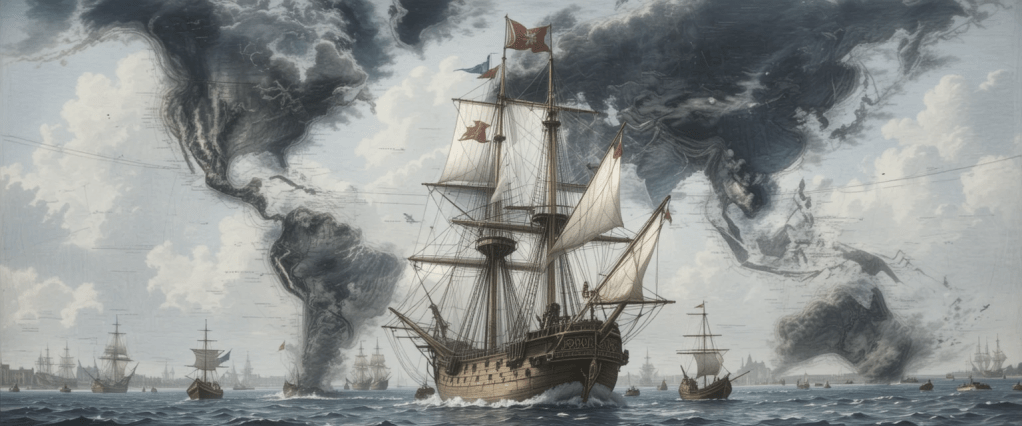
On March 20, 1602, the Dutch East India Company (Vereenigde Oostindische Compagnie or VOC) was officially founded, becoming the world’s first multinational corporation and one of the most influential trading enterprises in history. The VOC dominated global trade for nearly two centuries, facilitating extensive maritime commerce, cultural exchanges, and linguistic borrowings. This vast network of interactions brought numerous Dutch words and expressions into English, particularly in the realms of navigation, trade, finance, and everyday life.
1. Maritime and Trade Terminology
As Dutch merchants and sailors played a dominant role in global trade, many nautical and commercial terms from Dutch entered English, influencing how seafarers and traders communicated.
- “Yacht” (from Dutch jacht) – Originally referring to a light, fast sailing vessel used by the Dutch navy, it later came to mean a luxury sailing or motorboat.
- “Freight” (from Dutch vracht) – A term for goods transported by ship, truck, or train, now widely used in logistics and commerce.
- “Buoy” (from Dutch boei) – A floating marker used for navigation and safety at sea.
- “Skipper” (from Dutch schipper) – A term for a ship’s captain, which later extended to mean a leader or manager in other contexts.
- “Keelhaul” (from Dutch kielhalen) – Originally a severe naval punishment, it now means to harshly reprimand or punish someone figuratively.
These words reflect the Dutch expertise in maritime technology and the extensive influence of the VOC in shaping English nautical language.
2. Economic and Financial Terms
As the VOC pioneered modern corporate practices, it introduced several financial and business concepts that became standard in English.
- “Stock” and “Shareholder” – The VOC was the first company to issue publicly traded shares, influencing the financial vocabulary of capitalism.
- “Dividend” – A term for profit distributions to shareholders, which became central to corporate finance.
- “Bond” – While originally a Dutch financial instrument, this word became essential to global banking and investment.
- “Boom” and “Bust” – The Dutch were key players in the first financial bubbles, such as the famous Tulip Mania, influencing terms that describe economic highs and crashes.
The VOC’s financial innovations paved the way for modern stock markets, and its terminology remains fundamental to economics and business English today.
3. Words Related to Everyday Life and Culture
Beyond commerce and navigation, English also absorbed Dutch words related to food, lifestyle, and everyday experiences due to extensive trade interactions.
- “Cookie” (from Dutch koekje) – Originally referring to small baked treats, this term replaced the British “biscuit” in American English.
- “Waffle” (from Dutch wafel) – A type of griddled pastry that became a popular breakfast food worldwide.
- “Coleslaw” (from Dutch koolsla, meaning “cabbage salad”) – A dish widely consumed in English-speaking countries.
- “Landscape” (from Dutch landschap) – Originally a term for paintings depicting scenery, it later became a common word for natural scenery itself.
These borrowings reflect how Dutch culture and commerce shaped not only trade and finance but also culinary and artistic vocabulary in English.
4. The Legacy of the VOC in English Language and Global Commerce
The Dutch East India Company was more than just a trading powerhouse—it was a linguistic bridge between Dutch and English, contributing a wealth of vocabulary that remains relevant today.
- The VOC’s influence on nautical terms helped standardise maritime English, still used by sailors worldwide.
- Its pioneering role in finance helped shape the language of stocks, banking, and investment.
- Dutch words related to food, lifestyle, and culture became commonplace in English-speaking societies, showing the far-reaching impact of global trade.
In many ways, the linguistic impact of the VOC reflects the power of commerce in shaping language, demonstrating how trade, exploration, and innovation leave lasting marks on the way people speak, write, and think.
A Lasting Linguistic Voyage
The founding of the Dutch East India Company on March 20, 1602, was not just a landmark in economic history—it was a defining moment in the evolution of English vocabulary. The words it introduced continue to shape the language of shipping, trade, business, and daily life, serving as a testament to the power of cross-cultural exchange.
Through maritime dominance, financial ingenuity, and global commerce, the VOC left an enduring legacy, proving that language—like trade—knows no borders.
From trade winds to tongue twists — the VOC set sail and left its mark on the English language!

Originally published on March 20, 2025, on The-English-Nook.com.
Visit my page to find out ‘What Happened on this Day?‘ and learn ‘The Word of the Day‘—you’ll find it here first and all in one place!
If you’re a language enthusiast, you’ll have access to a variety of resources, including short stories in English and Spanish, interesting readings, vocabulary, and much more—not just for English, but also for Spanish. Come check it out!
 What Happened on This Day?
Leave a comment