
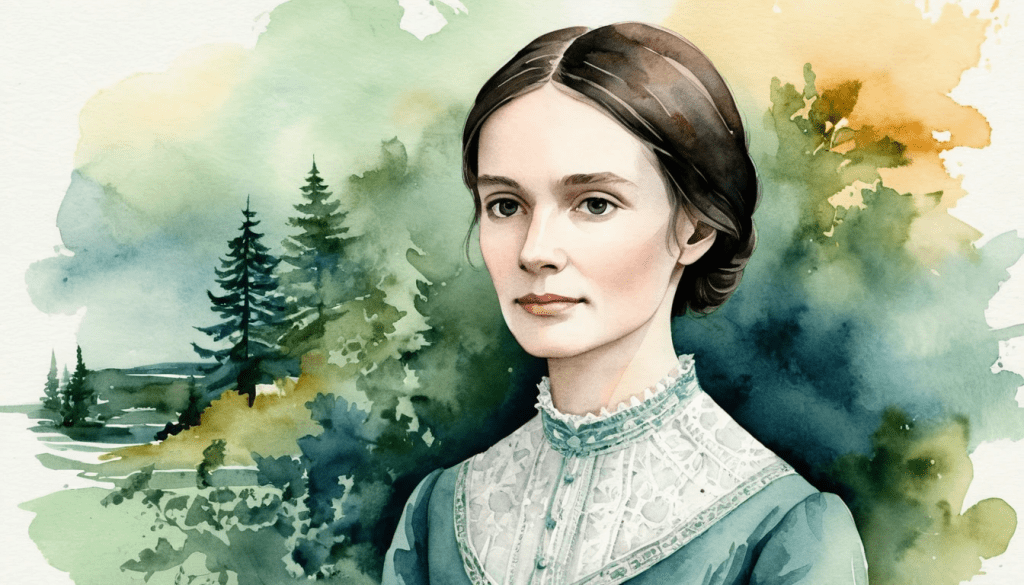
December 10, 1830
The Poet Who Taught English to Speak in Breaths and Lightning
On December 10, 1830, Emily Dickinson was born in Amherst, Massachusetts. Withdrawn from public life yet expansive in imagination, Dickinson became one of the most original and transformative voices in American and English-language poetry.
During her lifetime, her verse circulated only in fragments among family and friends; after her death, nearly 1,800 poems were discovered—compressed, enigmatic bursts of language that redefined the possibilities of English poetic expression. Her unconventional punctuation, fractured syntax, startling metaphors, and metaphysical intensity reshaped how English could think, feel, pause, and illuminate.
She wrote privately, but she revolutionized the English-language lyric.
1. Inventor of a New English Poetic Grammar
Dickinson’s poetic style broke from the conventions of Victorian English verse.
- Her use of dashes, disjunctive phrasing, and compressed imagery formed a new poetic syntax—almost a separate grammar within English.
- She dissolved the boundaries between sentence and line, letting breath itself become punctuation.
- Her poems hinge on interruption, ambiguity, and sudden revelation, turning English into a language of luminous fragments.
This grammar of the inward and the intuitive paved the way for modernist and postmodernist experimentation in English poetry.
2. The Metaphysics of the Everyday: A New Lyric Vision
Dickinson transformed ordinary English words—light, dew, door, soul—into portals of reflection.
- She layered domestic detail with cosmic speculation, merging the intimate and the infinite.
- Her metaphors unfolded not through ornament but through compression, making English feel simultaneously small and immense.
- She explored death, time, consciousness, and divinity with clarity and mystery intertwined.
Her introspective method influenced later poets’ understanding of English as a language capable of metaphysical intensity without grandeur.
3. Influence on Modern and Contemporary English-Language Poetry
Although her work became widely known only posthumously, Dickinson’s impact reverberated across the English-speaking literary world.
- Modernists such as T. S. Eliot, Marianne Moore, and Hart Crane saw in her poems a precursor to linguistic experimentation.
- Contemporary poets—from Sylvia Plath to Louise Glück—inherit her emotional precision and structural daring.
- Her intimate, fragmentary style helped shape the rise of free verse, compressed lyricism, and the short-form meditative poem in English.
She became a canonical presence, teaching English-language poets how to strip language down to essence.
4. A Private Voice with a Global English Echo
Dickinson rarely left her home, but her poetry traveled far beyond Amherst.
- Her work helped establish the American lyric voice within global English literature—idiosyncratic, inward, and metaphysical.
- Translations made her an international figure, yet the original English remains the site of her unmistakable music.
- Her manuscripts, with their variant word choices and spatial arrangements, expanded scholarly understandings of authorial intent and textual fluidity in English literature.
Her quiet life produced a seismic shift in how English thinks about poetry, authorship, and the boundaries of the lyric.
Glossary of Enduring Ideas from Dickinson
- Elliptical syntax — meaning through absence and interruption
- Lyric compression — dense, crystalline language
- Interior vastness — the cosmos reflected through the self
- Poetic dash — breath, hesitation, and revelation as form
- Mystical minimalism — spiritual depth through minimal expression
Dickinson’s Enduring Voice
Born on December 10, 1830, Emily Dickinson changed the shape of English poetry from behind a closed door. She revealed how English could whisper and thunder at once—how a single line could hold a universe.
Her secret poems became a public revolution.
One room, one voice, one immense silence — Emily Dickinson taught English to speak in sparks.
Curious about what happened today in history? Want to learn a new word every day?
You’ll find it all—first and in one place—at The-English-Nook.com!
If you love languages, this is your space.
Enjoy bilingual short stories, fun readings, useful vocabulary, and so much more in both English and Spanish.
Come explore!
 What Happened on This Day?
Leave a comment