
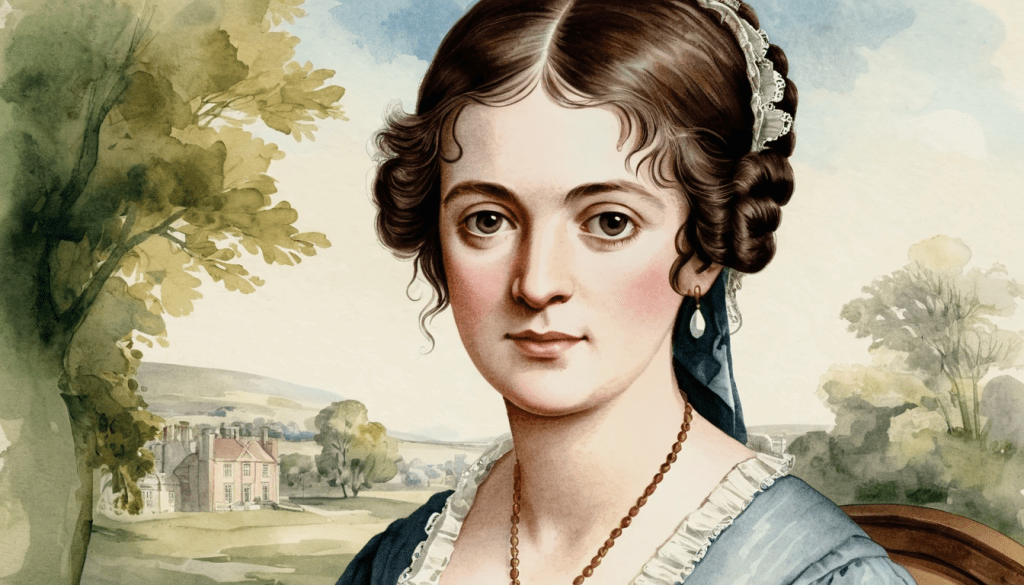
December 16, 1775
The Novelist Who Gave English Its Most Intelligent Voice
On December 16, 1775, Jane Austen was born in Steventon, Hampshire. Few dates matter more in the history of the English language. Austen stands not only as one of the greatest novelists in English, but as one of the most transformative figures in the evolution of English narrative voice, irony, and psychological realism.
Through novels such as Pride and Prejudice, Sense and Sensibility, Emma, Mansfield Park, and Persuasion, Austen reshaped English prose from within. She refined how English thinks on the page—how it balances judgment and sympathy, intimacy and distance, wit and moral seriousness.
She did not merely write novels.
She retrained English fiction’s consciousness.
1. The Refinement of Free Indirect Discourse
Austen perfected one of the most important techniques in English prose: free indirect discourse.
- She fused third-person narration with a character’s inner voice without quotation or explicit signaling.
- English learned to move fluidly between narrator and character, irony and intimacy.
- Thought, judgment, and emotion could coexist in a single sentence.
This innovation allowed English fiction to represent mental life with unprecedented subtlety—and became foundational for later novelists from George Eliot to Virginia Woolf.
2. The Modern Novel of Manners
Austen elevated everyday social life into serious literary subject matter.
- Drawing rooms, visits, conversations, and courtship became sites of moral drama.
- English prose learned to treat social nuance as meaningful action.
- Small choices revealed large ethical truths.
The novel of manners became a primary mode of English fiction because Austen proved it could carry depth, wit, and moral intelligence without melodrama.
3. Irony as an Ethical Instrument
Austen’s irony is not decorative—it is diagnostic.
- Her narrators gently expose self-deception, vanity, and moral blindness.
- Irony teaches readers how to judge without cruelty.
- English learned a new tone: amused, precise, and morally alert.
This form of irony shaped the ethical voice of English fiction, influencing how narrators relate to characters and how readers are taught to read.
4. Character as Language
Austen revolutionized characterization in English.
- Characters reveal themselves through speech patterns, judgments, and silences.
- Dialogue becomes a test of intelligence and moral awareness.
- Language itself becomes personality.
Elizabeth Bennet, Emma Woodhouse, and Anne Elliot are not just fictional people—they are modes of English thought embodied in voice.
5. Austen’s Long Shadow Over English Prose
The influence of Austen on English literature is continuous and foundational.
- She shaped the English novel’s narrative balance between closeness and critique.
- Her style informed Victorian realism, modernist interiority, and contemporary fiction alike.
- Her sentences remain models of clarity, compression, and intelligence.
Even writers reacting against Austen do so within a landscape she defined.
Glossary of Enduring Ideas from Austen
- Free indirect discourse — fused narrator–character consciousness
- Novel of manners — social life as moral drama
- Ethical irony — judgment without cruelty
- Psychological realism — inner life rendered through language
- Narrative intelligence — thought structured as style
Austen’s Central Place in English Literary History
Born on December 16, 1775, Jane Austen occupies a position of rare centrality in the English language. She taught English fiction how to observe, how to judge, and how to think with elegance and restraint. Her novels remain endlessly readable because they remain endlessly intelligent.
If English prose learned how to listen to itself, how to smile while thinking, how to reveal character through sentence and silence—it learned it from Austen.
One mind, one voice, one enduring grammar of intelligence — December 16 is the day English fiction learned how to be itself.
Curious about what happened today in history? Want to learn a new word every day?
You’ll find it all—first and in one place—at The-English-Nook.com!
If you love languages, this is your space.
Enjoy bilingual short stories, fun readings, useful vocabulary, and so much more in both English and Spanish.
Come explore!
 What Happened on This Day?
Leave a comment