
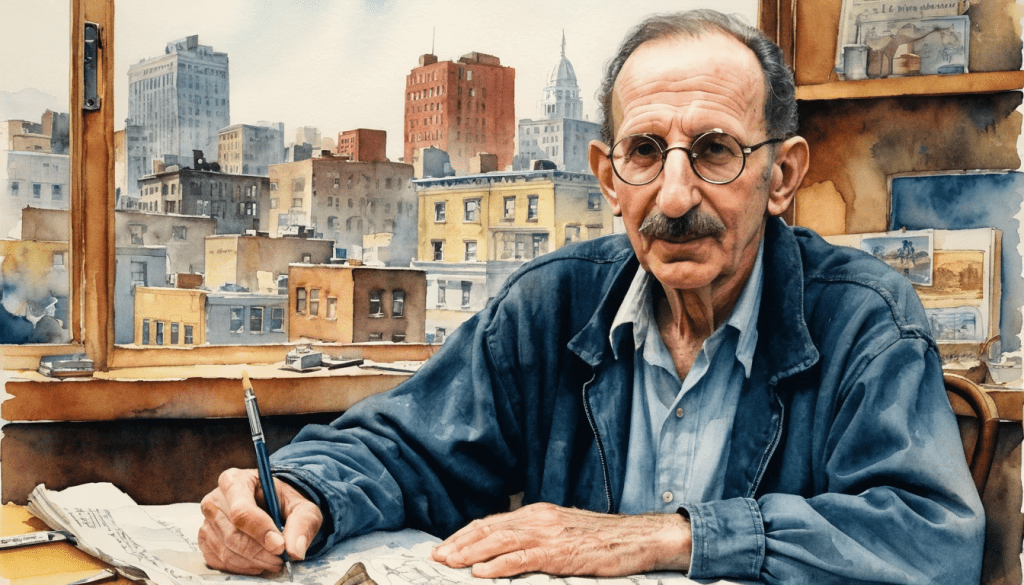
January 10, 1928
When American Poetry Learned to Speak from the Factory Floor
Philip Levine was born on January 10, 1928, in Detroit, Michigan—a city whose factories, labor rhythms, and economic violence would become inseparable from his poetic language. Over the course of five decades, Levine transformed American poetry by insisting that working-class English, long excluded or stylized from literature, was not only worthy of poetry but capable of carrying profound moral, emotional, and philosophical weight. His work permanently altered what English poetry could sound like, who it could speak for, and what kinds of lives it could center.
1. Restoring the Dignity of Ordinary American English
Levine rejected elevated, academic diction in favor of the plainspoken English he heard in factories, bars, kitchens, and union halls. His poems are built from short declarative sentences, concrete nouns, and everyday verbs, demonstrating that clarity could be as powerful as ornament. In doing so, he legitimized a register of English previously considered too rough, too local, or too unliterary for serious poetry.
Clarifying points
- Plain syntax as aesthetic choice
- Everyday vocabulary as moral stance
- Rejection of elitist literary diction
2. Work as a Central Subject of English Poetry
Before Levine, physical labor rarely occupied the center of modern American poetry without romanticization or abstraction. Levine wrote about repetitive motion, exhaustion, heat, noise, injury, and boredom in precise, unsentimental English. He expanded the thematic capacity of English poetry to include industrial labor as lived reality rather than metaphor.
Clarifying points
- Labor described concretely, not symbolically
- Factory life treated as intellectually serious
- Work becomes narrative, not backdrop
3. The Moral Weight of First-Person Working-Class Voice
Levine’s frequent use of the first person (“I”) was not confessional in the psychological sense but collective. His “I” often stands in for an entire class of speakers historically denied literary voice. This reoriented English lyric poetry toward witness rather than introspection, redefining authenticity as lived experience rather than emotional exhibition.
Clarifying points
- First person as representative voice
- Poetry as testimony
- Ethical authority rooted in experience
4. Anger, Restraint, and Controlled English Emotion
One of Levine’s most influential contributions was his ability to sustain anger without rhetoric. His English is emotionally charged yet syntactically restrained, avoiding exclamation or moralizing. This taught later poets how to encode rage, injustice, and resistance within calm grammatical structures—an enduring stylistic lesson in English literary craft.
Clarifying points
- Anger expressed through understatement
- Emotional force without exaggeration
- Grammar as ethical discipline
5. Expanding the Vocabulary of Class and Power
Levine’s poems stabilized and normalized a vocabulary of working-class life within literary English. Words relating to machinery, wages, shifts, fatigue, hierarchy, and physical strain entered poetry without translation or apology. This helped English absorb economic reality as a linguistic fact rather than a sociological abstraction.
Clarifying points
- Industrial and labor vocabulary normalized
- Class language integrated into poetry
- Economic reality made linguistically visible
6. Influence on American Poetic Lineage
Levine’s style reshaped generations of poets who sought to write clearly, ethically, and without pretension. His influence is evident in contemporary American poetry that favors narrative clarity, social grounding, and moral seriousness. As U.S. Poet Laureate (2011–2012), he symbolically affirmed that American English belongs to those who work in it, not only those who study it.
Clarifying points
- Long-term influence on poetic style
- Validation of accessible English poetry
- Institutional recognition of working-class voice
7. English as a Language of Resistance and Memory
Levine’s English is inseparable from memory—personal, communal, and historical. His poems preserve voices and experiences that industrial capitalism tends to erase. Through repetition, naming, and narrative recall, English becomes an archive of dignity and resistance rather than nostalgia.
Clarifying points
- Poetry as linguistic preservation
- Memory embedded in syntax
- Resistance enacted through naming
8. A Quiet but Permanent Expansion of English Poetry
Levine did not invent new forms or neologisms; instead, he reclaimed existing English and proved its sufficiency. He demonstrated that English, used honestly and precisely, could carry the weight of labor, injustice, endurance, and pride. This expansion was quiet—but irreversible.
Clarifying points
- Expansion through restraint, not innovation
- Ethical clarity over stylistic novelty
- Permanence through influence
Vocabulary and Linguistic Legacy
Philip Levine helped anchor a durable register of American poetic English, characterized by:
- plainspoken — direct, unadorned language
- shift, line, machine, foreman, wages — labor-specific vocabulary normalized in poetry
- endurance — moral persistence without triumph
- dignity — value asserted through restraint
- witness — speaking from experience rather than authority
Stylistically, his legacy includes:
- short declarative sentences
- narrative clarity
- moral seriousness without abstraction
Conclusion
Philip Levine’s birth on January 10 marks a turning point in the history of English poetry. He proved that the language of factories, fatigue, and survival was not a deviation from literary English but one of its deepest truths. By restoring dignity to ordinary speech and ordinary lives, Levine permanently widened the expressive range of English—and ensured that poetry would never again belong only to the privileged.
Poetry found its voice on the factory floor.
Curious about what happened today in history? Want to learn a new word every day?
You’ll find it all—first and in one place—at The-English-Nook.com!
If you love languages, this is your space.
Enjoy bilingual short stories, fun readings, useful vocabulary, and so much more in both English and Spanish.
Come explore!

 What Happened on This Day?
Leave a reply to Philip Levine (1928–2015) – The Poet Who Gave Working-Class English Its Permanent Voice – penwithlit Cancel reply