
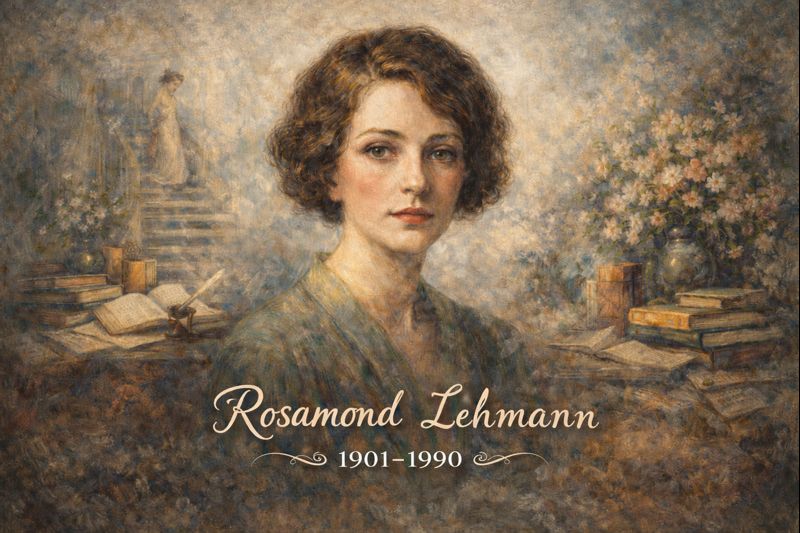
February 3, 1901
When English Learned to Register Quiet Feeling
On February 3, 1901, Rosamond Lehmann was born in Bourne End, England. A major British novelist of the early and mid-20th century, Lehmann is best known for works such as Dusty Answer (1927) and Invitation to the Waltz (1932). Though less publicly radical than some of her modernist contemporaries, Lehmann played a crucial role in refining English prose’s ability to articulate emotional nuance, social hesitation, and female interior life with clarity and restraint.
Emotional Precision Without Ornament
Lehmann’s prose is distinguished by its exact calibration of feeling. Rather than dramatizing emotion, she traces it—moment by moment, thought by thought—through carefully modulated sentences. In doing so, she strengthened English’s capacity to express gradual emotional change, especially in states of longing, embarrassment, anticipation, and disappointment.
Her writing reinforced a vocabulary of affect that relies on:
- understatement rather than confession
- psychological shading rather than declaration
- emotional accuracy over intensity
English gained a quieter, more exact language for inner life.
The Female Interior Voice in English Fiction
Lehmann’s novels are among the most sensitive English portrayals of women’s consciousness between adolescence and adulthood. Her narrative perspective centers on perception—how moments are felt rather than how they resolve—helping normalize female interiority as a central narrative authority rather than a marginal or romanticized one.
This influence stabilized critical and creative language around:
- interiority as lived experience
- emotional self-awareness without self-dramatization
- social constraint felt internally rather than imposed externally
Her work helped English fiction speak about women’s lives without rhetorical inflation or moral framing.
Social English and the Language of Gesture
Much of Lehmann’s achievement lies in her attention to social micro-language: pauses in conversation, half-spoken thoughts, gestures that carry emotional weight. Her prose makes English attentive to what is implied rather than stated.
Through her work, English narrative sharpened its ability to render:
- conversational hesitation
- unspoken tension
- emotional meaning carried by tone and timing
This sensitivity influenced later English novelists concerned with social realism and psychological depth.
Modernism Without Experiment as Shock
Although often grouped near modernism, Lehmann’s contribution lies not in formal rupture but in refinement. She demonstrated that English modern fiction could evolve by precision rather than disruption, deepening psychological realism without abandoning narrative continuity.
Her work helped broaden English modernism to include:
- subtle interior focus
- emotional realism without abstraction
- stylistic clarity paired with psychological depth
This made space for later writers who sought seriousness without overt experimentalism.
Critical Vocabulary and Legacy
In English literary criticism, Lehmann is frequently discussed using terms such as emotional realism, psychological nuance, feminine consciousness, and interwar interiority. These phrases owe much of their stability and usefulness to the kind of prose she practiced.
Her novels are now read not only as stories, but as models of how English can register feeling without excess.
Conclusion
Rosamond Lehmann’s birth on February 3 marks the arrival of a writer who quietly reshaped English prose from within. By insisting on emotional exactness, narrative patience, and the legitimacy of women’s inner lives, she expanded the expressive range of English without raising her voice.
February 3 stands as a meaningful date in English literary history: the day we remember the novelist who taught English how to feel precisely—and speak softly while doing so.
She taught English how feelings think.
Curious about what happened today in history? Want to learn a new word every day?
You’ll find it all—first and in one place—at The-English-Nook.com!
If you love languages, this is your space.
Enjoy bilingual short stories, fun readings, useful vocabulary, and so much more in both English and Spanish.
Come explore!
 What Happened on This Day?
Leave a comment