
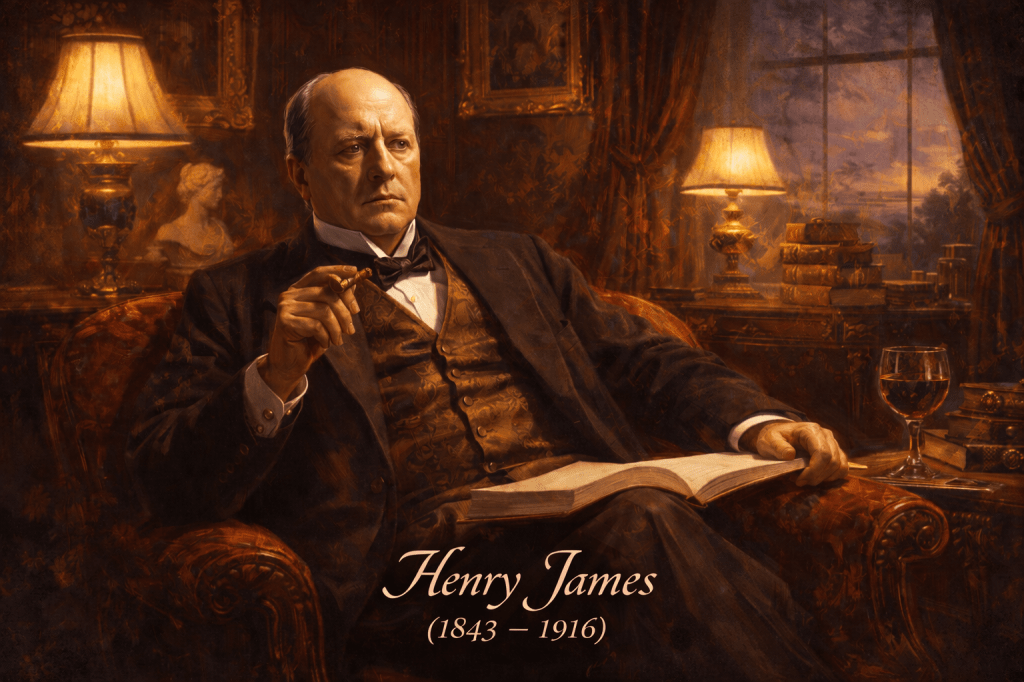
February 28, 1916
The Master of Psychological Realism and the Modern Sentence
On February 28, 1916, Henry James died in London, leaving behind one of the most refined bodies of prose in the English language. A transatlantic novelist who bridged American and British literary traditions, James transformed narrative technique through his deep exploration of consciousness, perception, and moral ambiguity. His stylistic innovations reshaped English prose at the turn of the twentieth century and influenced generations of modern writers.
1. Development of Psychological Realism in English Prose
James shifted the focus of the novel inward. Rather than centering plot alone, he made consciousness itself the primary field of drama, exploring subtle shifts in thought, motive, and perception.
Linguistic and narrative innovations:
- Detailed rendering of inner thought and subjective perception
- Emphasis on moral ambiguity rather than clear-cut judgment
- Use of limited point of view to filter reality through a single consciousness
- Slow revelation of meaning through reflection rather than action
- Elevation of social nuance and emotional undercurrents as narrative drivers
This inward turn laid groundwork for later modernist experimentation and deepened the psychological vocabulary of English fiction.
2. Complex and Nuanced Sentence Structures
James became known for his elaborate, carefully modulated syntax. His later prose, in particular, stretches the English sentence into a flexible instrument capable of capturing hesitation, qualification, and layered meaning.
Stylistic characteristics of his prose:
- Long, hypotactic sentences with multiple subordinate clauses
- Frequent use of qualification and refinement (perhaps, as it were, in a manner)
- Syntax that mirrors the movement of thought
- Delayed main clauses that build suspense and subtle emphasis
- Precision of diction paired with rhythmic elegance
His sentences demand attentiveness, rewarding readers with extraordinary psychological precision.
3. Influence on Modern Narrative Voice
James helped redefine the relationship between narrator, character, and reader. His “center of consciousness” technique shaped the evolution of narrative perspective in English literature.
Lasting impact on narrative technique:
- Development of free indirect style in refined form
- Blurring boundaries between narrator commentary and character perception
- Increased subtlety in unreliable or limited narration
- Heightened attention to what is implied rather than explicitly stated
- Greater interpretive responsibility placed on the reader
Writers such as Virginia Woolf and James Joyce extended this interior focus, but James provided a crucial bridge between Victorian realism and literary modernism.
4. Refinement of Social and Transatlantic Prose
James’s novels often explored the contrast between American innocence and European sophistication. Through this cultural tension, he refined a prose style attentive to manners, class, and subtle social codes.
Broader linguistic contributions:
- Expansion of vocabulary relating to perception, decorum, and sensibility
- Careful modulation of tone to reflect class and cultural difference
- Transformation of social interaction into psychological inquiry
- Integration of aesthetic theory into narrative structure
- Balance between realism and symbolic depth
His prose demonstrated that English could capture not only action and description, but the most delicate shades of awareness.
Final Thoughts
The death of Henry James on February 28, 1916, marked the passing of a writer who reshaped the architecture of English narrative. Through psychological realism, syntactic complexity, and refined narrative perspective, he expanded what English prose could express.
James did not merely tell stories—he taught the English sentence how to think.
He didn’t just write stories — he taught prose to think.
 What Happened on This Day?
Leave a comment