
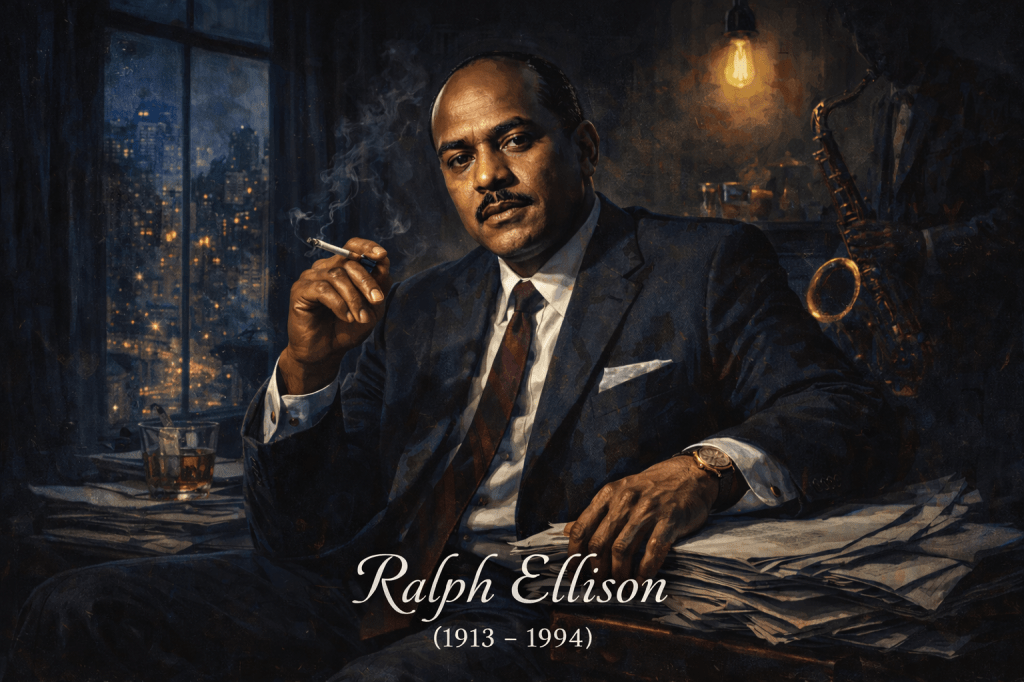
March 1, 1913
When the American Novel Learned to Speak in Layers
Born on March 1, 1913, Ralph Ellison would become one of the most powerful stylists of twentieth-century American prose. His landmark novel, Invisible Man, transformed the English-language novel by fusing political urgency, symbolic density, jazz rhythm, and philosophical depth. Ellison did not simply write about identity — he reshaped the language through which identity could be articulated in modern America.
1. Shaping the Modern African American Literary Voice
Ellison expanded the expressive range of African American prose without confining it to protest alone. He insisted that Black experience belonged at the center of American intellectual and artistic life.
Linguistic and cultural contributions:
- Integration of African American vernacular speech into high literary prose
- Elevation of oral traditions, sermons, and jazz cadence within written narrative
- Complex portrayal of racial identity beyond stereotype or slogan
- Expansion of English vocabulary around visibility, identity, and social erasure
- Assertion that African American narrative is foundational—not marginal—to American literature
His work helped redefine what counted as “American voice” in English fiction.
2. Elevating Rhetorical Layering and Symbolism
Invisible Man operates on multiple levels simultaneously: political allegory, psychological novel, philosophical inquiry, and social satire. Ellison mastered rhetorical layering, allowing symbolism and realism to coexist seamlessly.
Stylistic innovations:
- Dense symbolic motifs (light, blindness, invisibility, performance)
- Strategic shifts between realism, surrealism, and satire
- Use of speeches within the novel to examine rhetoric itself
- Juxtaposition of personal narrative and ideological language
- Irony as a structural rather than decorative device
Through this layering, Ellison expanded the interpretive demands of modern English prose.
3. Refining the Language of Identity and Selfhood
Ellison’s prose sharpened English discussions of identity by focusing on perception—how individuals are seen, misseen, or erased within social systems.
Lasting linguistic influence:
- Popularization of “invisibility” as a metaphor for social marginalization
- Nuanced articulation of double consciousness and fractured selfhood
- Deep exploration of performance, masking, and public persona
- Blending of philosophical vocabulary with lived experience
- Development of introspective narration grounded in social critique
His language bridged sociology, philosophy, and storytelling.
4. Influencing Modern Narrative Authority
Ellison demonstrated that a narrator could be both intensely personal and structurally symbolic. His voice carries authority not through detachment, but through rhetorical control and tonal complexity.
Narrative impact:
- First-person narration that is reflective, ironic, and self-aware
- Careful modulation between confession and critique
- Rhythmic prose influenced by jazz improvisation
- Elevated diction balanced with colloquial energy
- Expansion of the American novel’s moral and rhetorical ambition
His influence can be felt in later writers who combine political consciousness with stylistic sophistication.
Final Thoughts
The birth of Ralph Ellison on March 1, 1913, marks a turning point in the evolution of American English prose. Through rhetorical richness, symbolic layering, and a redefinition of narrative voice, he expanded the expressive and philosophical capacity of the modern novel.
Ellison did not merely write about invisibility — he gave English a new way to make it visible.
 What Happened on This Day?
Leave a comment