
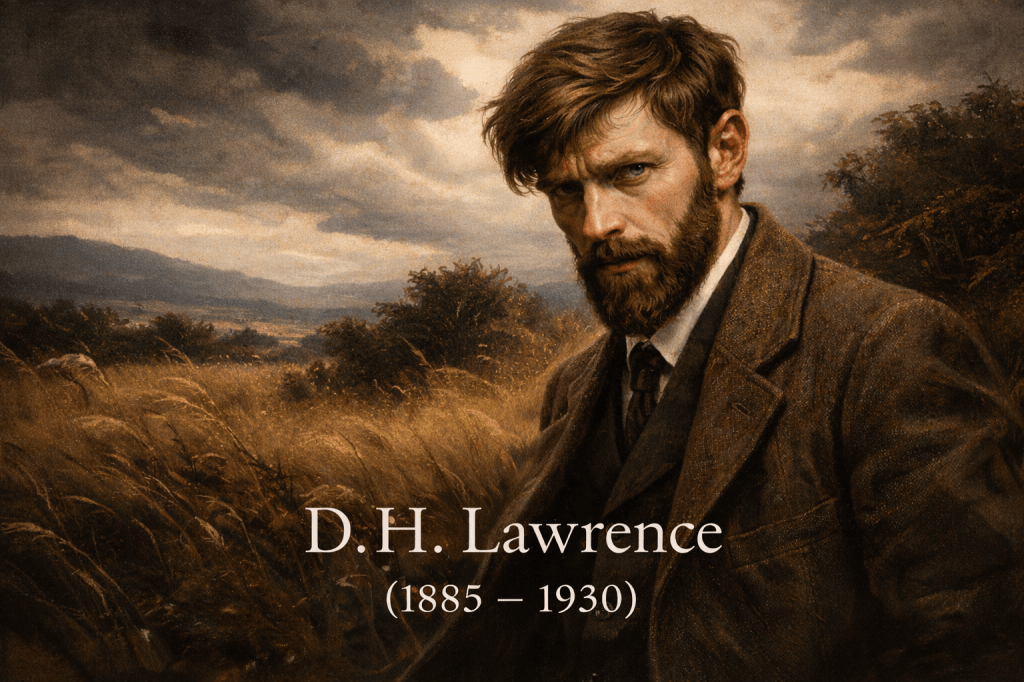
March 2, 1930
The Novelist Who Forced English to Confront Desire, Instinct, and Modern Alienation
When D. H. Lawrence died on March 2, 1930, he left behind not merely a body of controversial novels, but a transformed literary language. As one of the central figures of literary modernism, Lawrence expanded the expressive capacity of English prose—psychologically, emotionally, and physically. His fiction insisted that the English novel must speak openly about instinct, sexuality, class tension, industrial modernity, and the fractured inner life of the individual.
His legacy lies not only in subject matter, but in tone, rhythm, and narrative daring.
1. Expanding Psychological Realism in English Prose
Lawrence intensified psychological realism by moving beyond surface consciousness into instinct and subconscious impulse. In works such as Sons and Lovers and Women in Love, emotional life is not explained calmly—it pulses, surges, and collides.
Language contributions:
- Penetrating exploration of subconscious drives and emotional contradiction
- Vocabulary that fuses physical sensation with mental and spiritual states
- Rhythmic, almost incantatory prose reflecting inner turbulence
- Heightened emotional diction that mirrors psychological intensity
- Refusal of detached narration in favor of immersive interiority
Lawrence made English prose more visceral. Feelings are not merely described; they are enacted syntactically, through repetition, cadence, and emotional volatility.
2. Transforming the Language of Sexuality and the Body
Perhaps no modernist writer altered the vocabulary of sexuality in English fiction as radically as Lawrence. With Lady Chatterley’s Lover, he challenged both prudish convention and legal censorship, arguing that bodily experience was inseparable from spiritual truth.
Linguistic and cultural consequences:
- Direct and unapologetic depiction of sexual relationships
- Reclaiming of taboo words into literary seriousness
- Integration of erotic intimacy into philosophical discourse
- Framing physical connection as existential necessity
- Expansion of emotional vocabulary surrounding desire, tenderness, and vulnerability
Lawrence refused euphemism. In doing so, he permanently altered what English literary prose could acknowledge without disguise.
3. Influencing Debates on Censorship and Expressive Freedom
The legal battles surrounding Lady Chatterley’s Lover—particularly the landmark 1960 obscenity trial in Britain decades after his death—cemented Lawrence’s role in reshaping the limits of publication.
Broader impact on English literary culture:
- Redefinition of obscenity in relation to artistic intention
- Expansion of permissible subject matter in mainstream fiction
- Strengthening of “freedom of expression” as a literary principle
- Increased critical discussion of morality versus art
- Normalization of candid language in serious novels
Lawrence became central to twentieth-century debates about whether literature should protect public sensibility—or challenge it.
4. Contributing to Modernist Experimentation and Narrative Intensity
Although stylistically distinct from contemporaries like James Joyce and Virginia Woolf, Lawrence shared the modernist determination to break conventional realism. His prose abandons Victorian restraint for emotional extremity and symbolic force.
Modernist features in his writing:
- Fragmented emotional pacing rather than linear calm narration
- Symbolic use of landscape and nature as psychological mirrors
- Philosophical meditation embedded within narrative movement
- Ambiguous moral resolutions that resist neat closure
- Intensely subjective, often unstable narrative perspective
His style is urgent, charged, and frequently confrontational. It demands that readers feel as much as they interpret.
Final Thoughts
The death of D. H. Lawrence on March 2, 1930, marked the end of one of the boldest experiments in modern English prose. He expanded psychological realism, revolutionized the literary treatment of sexuality, and helped redefine the boundaries of expressive freedom.
After Lawrence, English fiction could no longer retreat into polite distance. The body, the instinct, the forbidden, and the emotionally raw had entered the language permanently—and the novel was never the same again.
He stripped the novel of politeness — and left it burning with life.
 What Happened on This Day?
Leave a comment