
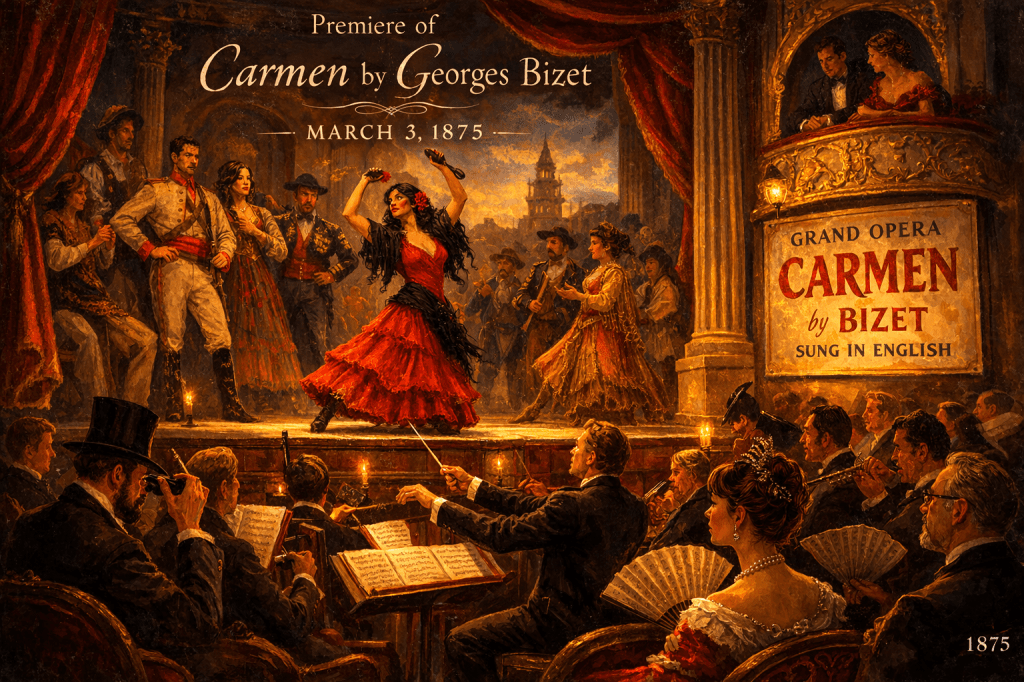
March 3, 1875
When Passion, Realism, and Fatalism Entered English Theatrical Language
Premiering in Paris on March 3, 1875, Carmen shocked audiences with its sensual realism, moral ambiguity, and tragic inevitability. Though French in origin, its rapid translation and performance in English-speaking countries profoundly influenced theatrical vocabulary, character archetypes, and the language of dramatic passion in English culture.
1. Expanding Theatrical Vocabulary in English Performance Culture
As Carmen entered English opera houses and theatres, its terminology, character types, and dramatic framing became embedded in performance language.
Linguistic and theatrical consequences:
- Popularization of terms such as mezzo-soprano, aria, and libretto in broader English usage
- Reinforcement of “opera” as shorthand for heightened emotional drama
- Establishment of the “Carmen type” as a cultural descriptor
- Greater integration of European operatic terminology into English criticism
- Growth of music journalism with specialized performance vocabulary
Opera criticism in English became more technical, expressive, and analytically precise.
2. Shaping Archetypes of Passion and Fatalism
The character of Carmen became a defining literary and theatrical archetype: independent, sensual, defiant, and ultimately tragic. English translations preserved not only plot but tonal intensity.
Narrative and stylistic influence:
- Reinforcement of the “femme fatale” figure in English storytelling
- Expansion of vocabulary surrounding seduction, freedom, jealousy, and doom
- Heightened melodramatic structure built around inevitability and fate
- Increased use of irony, especially dramatic irony, in romantic tragedy
- Fusion of realism with symbolic fatalism
This model influenced later English drama, fiction, and even popular storytelling.
3. Advancing Realism in Musical and Dramatic Expression
Unlike mythic or aristocratic operas before it, Carmen centered on working-class characters and morally ambiguous choices. Its realism altered expectations of what stage drama could portray.
Impact on English dramatic language:
- Greater acceptance of morally complex protagonists
- Incorporation of colloquial or socially marked speech in performance
- Emphasis on psychological motivation over idealized heroism
- Blending of lyric beauty with raw emotional conflict
- Stronger alignment between music, mood, and narrative pacing
This shift paralleled the broader movement toward realism in late nineteenth-century English literature.
4. Influencing Symbolism and Cultural Metaphor
Beyond the stage, Carmen entered English metaphorical language. Her name became shorthand for dangerous allure and rebellious autonomy.
Long-term linguistic effects:
- Use of “Carmen-like” to signify passion and defiance
- Association of Spain (often romantically imagined) with intensity and sensuality
- Symbolic pairing of love and death in dramatic expression
- Reinforcement of exoticism as a literary device
- Expansion of theatrical metaphor in journalism and criticism
Opera thus moved beyond music into cultural shorthand within English prose.
Final Thoughts
The premiere of Carmen on March 3, 1875, did more than introduce a controversial opera. Through translation and performance, it enriched English theatrical vocabulary, solidified enduring archetypes, and deepened the expressive range of dramatic language.
In giving the world Carmen, Bizet helped give English storytelling a new language of passion and fatal inevitability.
She didn’t just seduce Don José — she seduced the language of drama.
 What Happened on This Day?
Leave a comment