
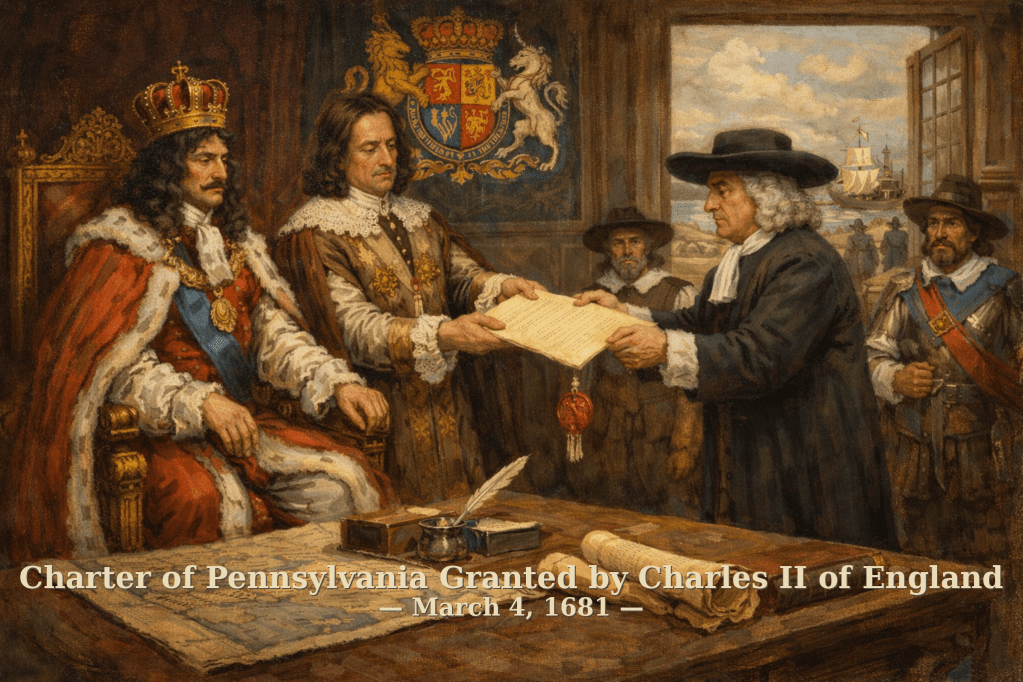
March 4, 1681
When Royal Bureaucracy Shaped the Language of American Governance
On March 4, 1681, Charles II granted a royal charter for the Province of Pennsylvania to William Penn. What began as a political and financial arrangement between crown and proprietor became a decisive moment in the transplantation—and transformation—of English legal, administrative, and religious language in North America. The document did more than establish territory; it embedded forms of English governance and prose that would influence American writing for generations.
1. Establishing English Legal and Administrative Language in the Colonies
The Pennsylvania charter carried with it the formal structures of English constitutional and property law. Through this document, bureaucratic English crossed the Atlantic in authoritative form.
Linguistic consequences in colonial governance:
- Standardization of legal terminology such as charter, proprietor, assembly, and province
- Formalized phrasing for land grants, rights, and jurisdiction
- Adoption of structured preambles and declarative clauses in official documents
- Reinforcement of monarchic and constitutional vocabulary
- Institutionalization of written record-keeping and legal prose conventions
This administrative language became foundational to later colonial legislation and, eventually, American constitutional writing.
2. Influencing Quaker Writing and Plain Style Prose
William Penn, a prominent Quaker, infused Pennsylvania’s civic and religious life with Quaker rhetorical principles. The Society of Friends favored clarity, moral seriousness, and directness over ornament.
Impact on English prose traditions in America:
- Preference for plain style over elaborate rhetorical flourish
- Emphasis on ethical clarity and spiritual introspection
- Use of direct address and moral persuasion in pamphlets and letters
- Expansion of vocabulary related to conscience, liberty, and inward light
- Development of reflective, reform-oriented civic writing
This Quaker-inflected prose helped shape early American political and religious discourse.
3. Encouraging Colonial Political Writing and Debate
Pennsylvania quickly became a center of pamphleteering, legislative debate, and civic argument. The legal framework provided by the charter stimulated active political participation through writing.
Rhetorical developments in colonial English:
- Growth of petitionary and argumentative prose
- Increased emphasis on rights, representation, and self-governance
- Clear articulation of contractual political relationships
- Structured debate modeled on parliamentary discourse
- Early blending of religious conviction with civic policy language
Such writing laid groundwork for the argumentative style that would later define revolutionary rhetoric.
4. Preparing the Ground for American Constitutional Language
Though still under British rule, the charter embodied principles that would echo in later American political documents.
Long-term linguistic implications:
- Reinforcement of charter-based legitimacy in governance
- Expansion of vocabulary around liberty, property, and lawful authority
- Normalization of written constitutions as governing instruments
- Development of procedural clarity in legislative writing
- Influence on the emerging tone of American civic prose
The bureaucratic and moral language carried into Pennsylvania would evolve into a distinctly American political idiom.
Final Thoughts
The granting of Pennsylvania’s charter on March 4, 1681, was more than a colonial transaction. It transported English legal precision, administrative structure, and religious plain style into a new world—where they would be adapted, debated, and eventually transformed.
From royal decree to constitutional principle, the English of empire became the English of American self-government.
From royal ink to constitutional voice — bureaucracy became a new nation’s language.
 What Happened on This Day?
Leave a comment