
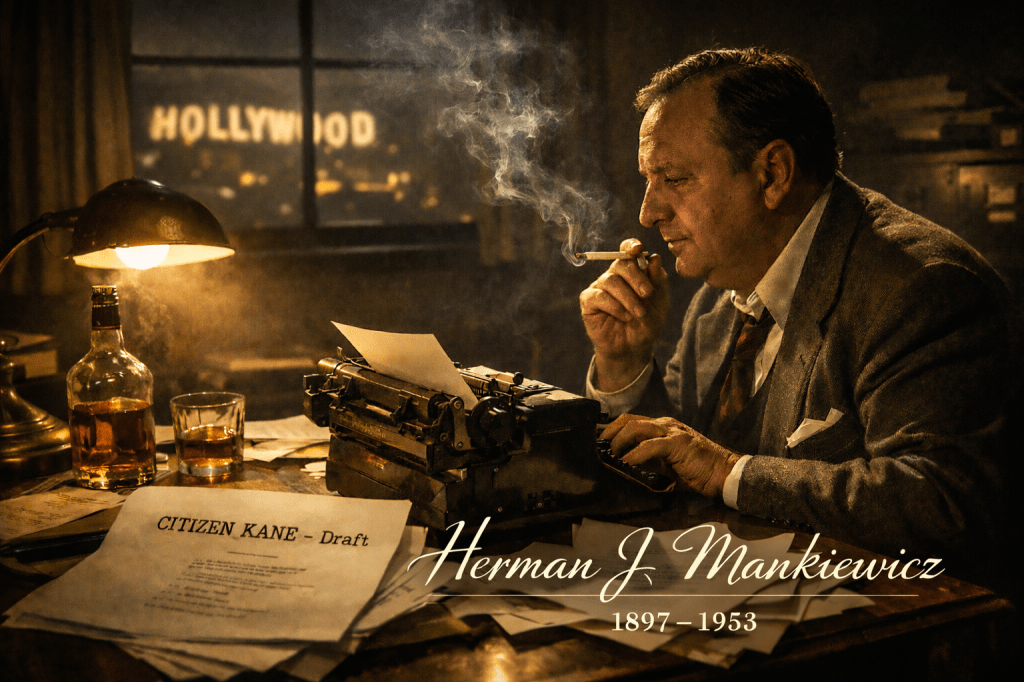
March 5, 1953
When Cinematic Dialogue Became a New Form of Literary English
The death of Herman J. Mankiewicz on March 5, 1953, marked the passing of one of the most influential voices in early American screenwriting. Best known as co-writer of Citizen Kane with Orson Welles, Mankiewicz helped transform the screenplay into a sophisticated form of English narrative—blending journalistic wit, theatrical rhythm, and literary dialogue. His writing demonstrated that film scripts could achieve the same linguistic complexity and rhetorical sharpness traditionally associated with novels and stage drama.
1. Elevating the Screenplay as a Literary Form
Before the 1940s, many film scripts were treated primarily as technical documents. Mankiewicz’s work on Citizen Kane demonstrated that cinematic writing could possess intellectual depth and stylistic sophistication.
Key contributions to English narrative writing:
- Complex narrative layering through flashbacks and multiple perspectives
- Dialogue rich in irony, rhetorical play, and characterization
- Integration of journalistic tone with dramatic storytelling
- Development of screenplay structure as a literary architecture
- Demonstration that visual narrative could coexist with powerful language
The Citizen Kane script remains widely studied in film schools and writing programs as one of the most influential English-language screenplays ever written.
2. Shaping the Language of Modern Cinematic Dialogue
Mankiewicz brought a distinctive verbal style to Hollywood—sharp, urbane, and intellectually playful. His dialogue helped establish the tone that would define sophisticated American cinema.
Linguistic characteristics of his style:
- Rapid, witty exchanges resembling stage comedy and newspaper prose
- Use of sarcasm, understatement, and verbal irony
- Memorable rhetorical phrasing and quotable lines
- Blending of high cultural references with everyday speech
- Strong characterization through speech patterns
This style influenced generations of screenwriters who sought to make dialogue central to cinematic storytelling.
3. Influencing Narrative Voice in Film and Television
The narrative structure of Citizen Kane introduced storytelling techniques that reshaped narrative voice across English-language film and television.
Narrative innovations reflected in later writing:
- Fragmented storytelling built through testimonies and recollections
- Investigative narrative frameworks resembling journalistic inquiry
- Exploration of unreliable memory and subjective perspective
- Character portraits constructed through multiple narrative voices
- Greater emphasis on psychological complexity in dialogue
These techniques would later become staples of modern narrative media.
4. Bridging Journalism, Theatre, and Film Language
Mankiewicz came from a background in journalism and theatre criticism, and this background profoundly shaped his writing.
Cross-disciplinary linguistic influence:
- Journalistic concision combined with theatrical dramatic tension
- Sophisticated rhetorical phrasing adapted to cinematic pacing
- Narrative commentary embedded within dialogue and scene structure
- Intellectual tone unusual for early Hollywood screenwriting
- A model for later writer-driven filmmaking traditions
His approach helped blur the boundary between literary writing and cinematic storytelling.
Final Thoughts
Herman J. Mankiewicz’s death in 1953 closed the career of a writer who helped redefine how English functions on screen. Through Citizen Kane and other works, he showed that film dialogue could rival the sharpness of theatre and the complexity of modern prose.
In doing so, he helped establish the screenplay as a legitimate and influential form of English literary expression—one that continues to shape storytelling across cinema, television, and modern media.
When the screenplay learned to speak like literature. 🎬📜
 What Happened on This Day?
Leave a comment