
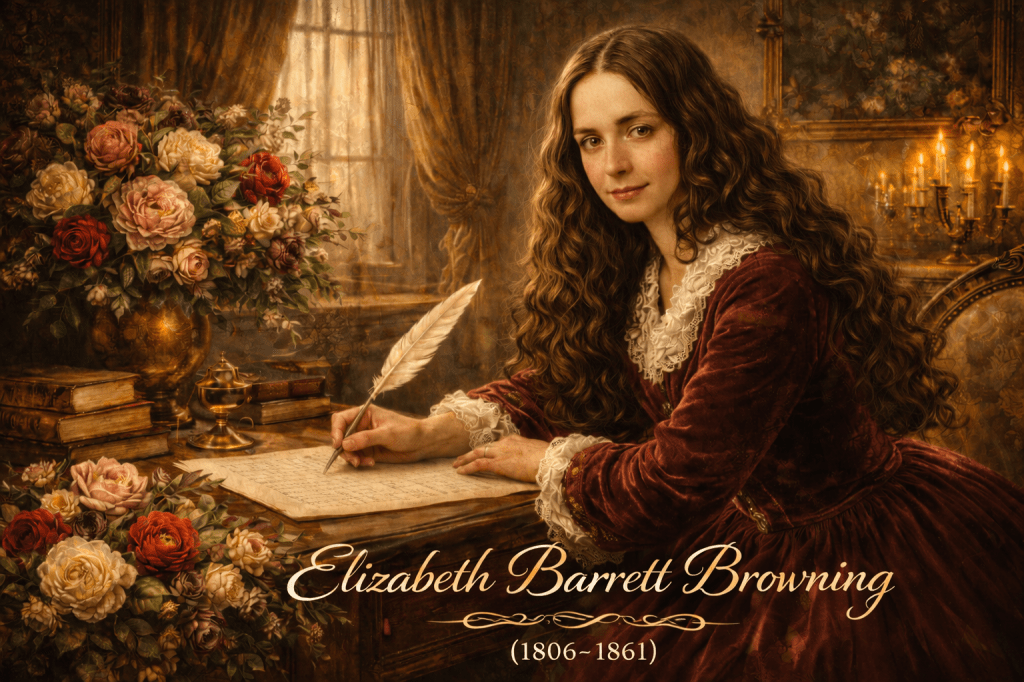
March 6, 1806
A Poet Who Expanded the Emotional and Intellectual Range of Victorian English
The birth of Elizabeth Barrett Browning on March 6, 1806, introduced one of the most powerful poetic voices of the nineteenth century. Celebrated for works such as Sonnets from the Portuguese and Aurora Leigh, she helped expand the expressive possibilities of English poetry during the Victorian era. Her writing blended lyric intensity with intellectual argument, shaping both the emotional vocabulary and the rhetorical ambition of modern English verse.
1. Expanding the Language of Love Poetry
Barrett Browning’s Sonnets from the Portuguese remains one of the most influential love-poetry sequences in English literature.
Key linguistic contributions:
- Elevated the sonnet sequence as a vehicle for personal emotional exploration
- Combined classical poetic structure with intimate conversational tone
- Popularized memorable lines such as “How do I love thee? Let me count the ways.”
- Expanded the vocabulary of romantic expression in English poetry
- Demonstrated how lyric poetry could express both passion and reflective thought
These sonnets became foundational models for later English love poetry.
2. Transforming the Narrative Possibilities of Poetry
With Aurora Leigh, Barrett Browning produced one of the most ambitious long poems of the Victorian era.
Narrative and stylistic innovations:
- Blended novelistic storytelling with poetic form
- Used blank verse to sustain extended narrative argument
- Explored themes of gender, artistic identity, and social responsibility
- Created a hybrid genre often described as a “novel in verse”
- Demonstrated that poetry could carry complex philosophical and social debates
This work broadened expectations for what English poetry could achieve narratively.
3. Shaping Victorian Literary Language and Social Debate
Barrett Browning used poetry not only for personal expression but also as a medium for moral and political reflection.
Influence on Victorian intellectual language:
- Addressed issues such as child labor, women’s rights, and social justice
- Integrated political argument with lyrical expression
- Modeled the use of poetry as a vehicle for ethical discourse
- Contributed to the development of socially engaged literary language
- Influenced Victorian readers’ expectations that poetry could address real-world problems
Her work helped establish the Victorian ideal of literature as both aesthetic and socially responsible.
4. Influence on Later English Poets
Barrett Browning’s stylistic confidence and intellectual ambition influenced generations of English-language writers.
Literary legacy:
- Helped legitimize female poetic authority in the English literary tradition
- Influenced later poets interested in combining lyric voice with narrative form
- Strengthened the role of psychological introspection in Victorian poetry
- Expanded the emotional and rhetorical range available to English verse
- Remains widely studied for her command of poetic argument and voice
Her poetry demonstrated that lyric expression could be at once intimate, intellectual, and socially engaged.
Final Thoughts
Elizabeth Barrett Browning stands among the most important poets of the nineteenth century. Through works like Sonnets from the Portuguese and Aurora Leigh, she reshaped the expressive possibilities of English poetry—expanding its emotional depth, narrative scope, and moral ambition.
Her legacy endures in the continuing evolution of English lyric poetry and in the broader tradition of writers who see poetry as a powerful medium for both personal expression and social reflection.
She proved poetry could feel deeply, think boldly,
and argue with the elegance of a song.
 What Happened on This Day?
Leave a comment