
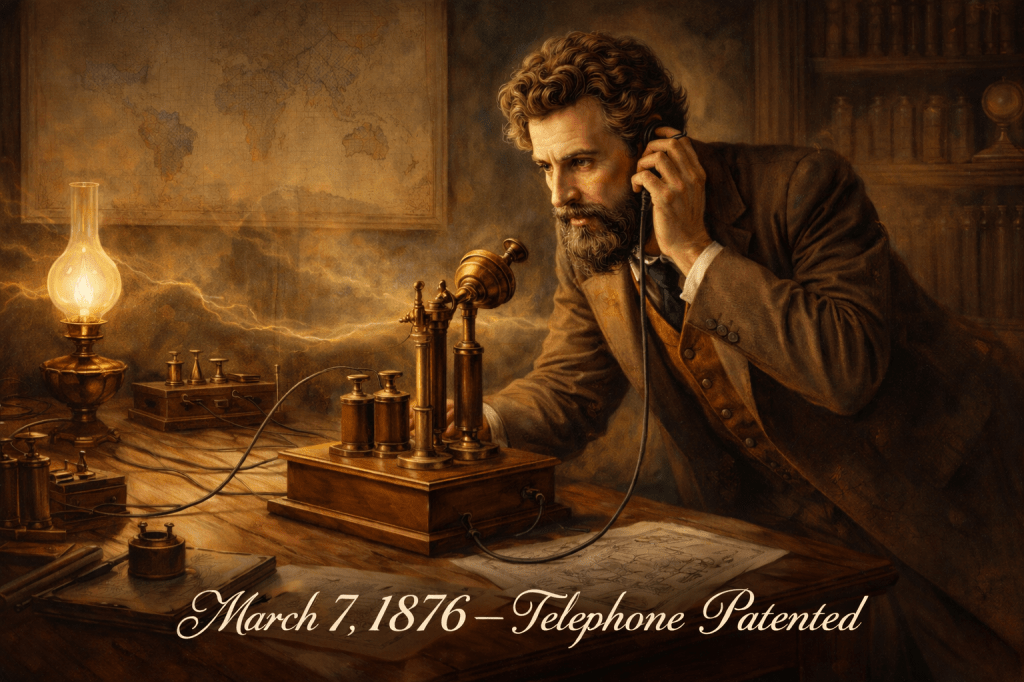
March 7, 1876
When Spoken English Escaped the Limits of Distance
On March 7, 1876, Alexander Graham Bell received U.S. Patent No. 174,465 for the telephone, an invention that permanently transformed human communication. For the first time in history, spoken language could travel instantly across great distances, allowing real-time conversation between people separated by cities, regions, and eventually continents. This technological breakthrough did not merely change engineering and commerce—it reshaped how English speakers interacted, structured conversations, and developed new linguistic conventions for remote speech.
1. The Birth of Real-Time Long-Distance Speech
Before the telephone, written communication—letters, telegrams, and printed documents—dominated long-distance interaction. The telephone suddenly allowed the spoken voice to travel beyond physical presence.
Key linguistic consequences:
- Enabled synchronous conversation across distance
- Reinforced spoken English as a primary medium of rapid communication
- Encouraged conversational spontaneity instead of delayed written exchange
- Expanded the everyday use of informal spoken language in professional settings
- Accelerated the spread of spoken idioms, accents, and conversational habits
In essence, the telephone extended the reach of everyday speech far beyond the room in which it was spoken.
2. The Emergence of Telephone Etiquette and New Conversational Forms
The telephone created entirely new social situations that required linguistic adaptation. Because speakers could not see one another, English developed conventions to structure these unfamiliar conversations.
Examples of emerging telephone language:
- Greeting formulas such as “Hello?”, which became standard partly through early telephone use
- Identity-confirming phrases like “Who’s speaking?” or “May I ask who’s calling?”
- Opening structures such as “Is this…” and “May I speak to…”
- Closing formulas including “Goodbye,” “Talk to you later,” and “I’ll call back”
- Clarification phrases like “Can you hear me?” and “The line is breaking up.”
These conventions created an entire micro-genre of spoken English: the telephone conversation.
3. Expanding English Communication Networks
As telephone networks expanded across the United States and the English-speaking world, they reinforced English as a practical language of business, administration, and daily life.
Broader linguistic effects:
- Accelerated commercial communication in English
- Encouraged standardized conversational phrasing in professional contexts
- Supported rapid coordination in journalism, politics, and commerce
- Helped normalize spoken English in formal decision-making environments
- Contributed to the rise of voice-based service professions such as operators and receptionists
The telephone also created new terminology in English such as operator, long-distance call, switchboard, dial, and busy signal.
4. A Foundation for the Modern Voice Economy
The telephone laid the groundwork for later communication technologies that rely heavily on spoken English.
Technological and linguistic legacy:
- Radio interviews and broadcast conversation
- Customer-service call centers and scripted speech
- Conference calls and remote business meetings
- Voice messaging and teleconferencing
- The modern culture of voice communication through mobile phones
These developments expanded the domains in which spoken English operates daily.
Final Thoughts
The patenting of the telephone in 1876 marked a turning point in the history of language use. By freeing spoken conversation from physical proximity, the invention transformed English into a truly long-distance spoken medium. New conversational etiquette, new vocabulary, and entirely new communicative situations emerged from this technological shift—changes that continue to shape how English speakers interact in the modern world.
The day the human voice learned how to travel.
 What Happened on This Day?
Leave a comment