
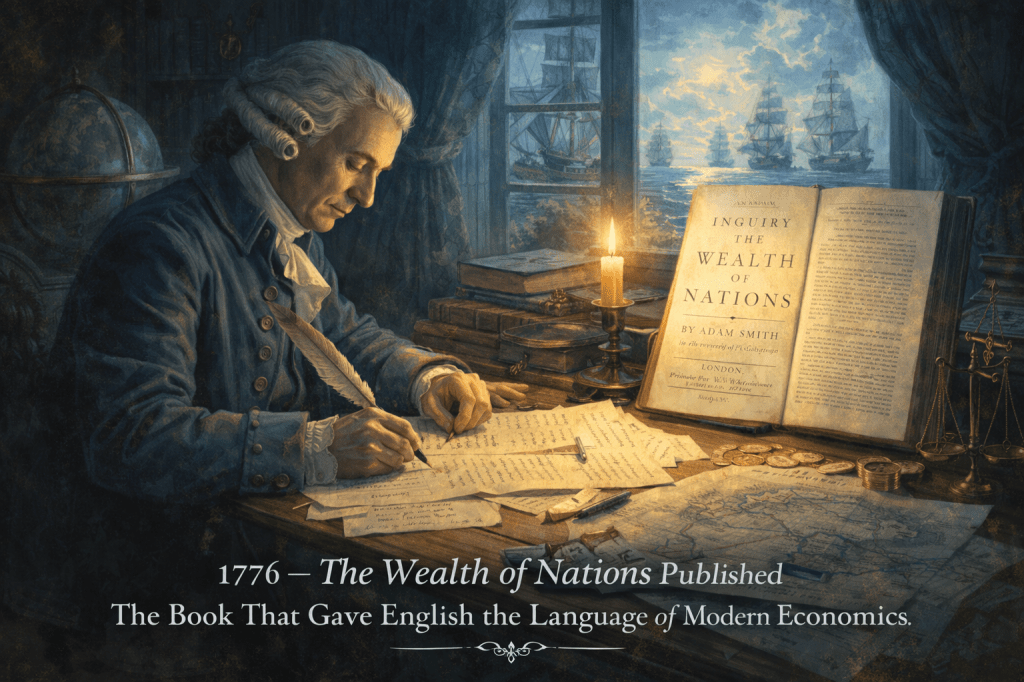
March 9, 1776
When Economic Thought Found Its Defining English Vocabulary
On March 9, 1776, An Inquiry into the Nature and Causes of the Wealth of Nations by Adam Smith was published in London. This monumental work became one of the most influential texts ever written on political economy. Beyond its economic theories, Smith’s book played a decisive role in shaping the language of modern economic discourse in English, establishing terminology, argument structures, and rhetorical clarity that still define economic writing today.
1. The Birth of Modern Economic Vocabulary in English
Smith’s work provided a systematic framework for discussing economic life in clear and persuasive English prose. Many of the concepts he described either introduced new terminology or firmly established phrases that became central to economic analysis.
Key expressions associated with Smith’s work include:
- division of labor
- invisible hand
- free market
- economic self-interest
- productive labor and unproductive labor
- market price vs. natural price
These phrases gave English a precise vocabulary for discussing production, exchange, and economic organization—language that remains foundational in economics, journalism, and public policy debates.
2. A Model of Analytical Prose in English
Smith’s writing also helped shape the style of analytical argument in English nonfiction. His prose combines philosophical reasoning with concrete examples, making complex economic ideas accessible without sacrificing intellectual rigor.
His rhetorical style helped establish key characteristics of modern academic and policy writing:
- structured argumentation, where claims are carefully built through evidence and reasoning
- illustrative examples, such as the famous pin factory used to explain the division of labor
- a balance between philosophical reflection and empirical observation
- prose that strives for clarity, logical progression, and persuasive explanation
This approach influenced later generations of economists, historians, and political thinkers writing in English.
3. The Expansion of Political and Social Vocabulary
The influence of The Wealth of Nations extended far beyond economics. Its ideas helped shape the vocabulary used to discuss government, commerce, taxation, and trade, particularly during the late 18th and 19th centuries.
Concepts widely discussed in English discourse following Smith’s work include:
- free trade
- competition and market forces
- economic growth and national wealth
- public works and state intervention
- the relationship between individual liberty and economic activity
These ideas became central to political debate in Britain, the United States, and other English-speaking societies during the age of industrialization.
4. A Foundation for Modern Economic and Political Writing
Over time, Smith’s book became a cornerstone for later thinkers writing in English about economics and society. Its terminology and conceptual framework shaped the language used by economists, policymakers, journalists, and historians.
The legacy of The Wealth of Nations includes:
- the establishment of economic analysis as a major form of English intellectual prose
- the normalization of technical vocabulary for markets and trade
- the development of policy-oriented writing about commerce, taxation, and regulation
- the enduring presence of Smith’s key terms in modern economics, political science, and public debate
Final Thoughts
The publication of The Wealth of Nations in 1776 did more than launch modern economic theory—it helped create the linguistic framework through which economic life is discussed in English. Through clear argumentation and influential terminology such as division of labor and invisible hand, Adam Smith gave English a durable vocabulary for analyzing markets, production, and national prosperity—language that continues to shape economic thought and discourse around the world.
The book that taught the world how to talk about wealth.
 What Happened on This Day?
Leave a comment