
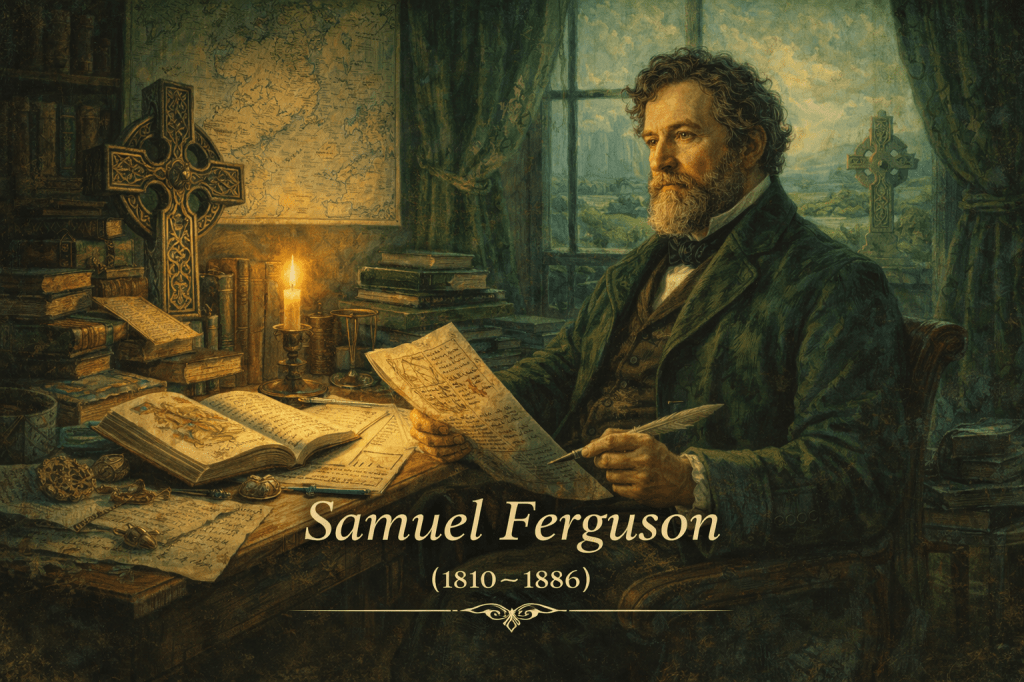
March 10, 1810
When Celtic Legend Found a New Voice in English Poetry
Born on March 10, 1810, Samuel Ferguson became one of the earliest and most important figures in the revival of Irish mythological and historical themes within English-language literature. Poet, antiquarian, and scholar, Ferguson worked to recover Ireland’s ancient stories and cultural traditions, translating them—both linguistically and artistically—into English poetry and prose. His work helped prepare the intellectual and literary ground for the later Celtic Revival and influenced writers who sought to reconnect English literature with Irish mythic heritage.
1. Reviving Irish Mythology within English Literary Culture
Ferguson devoted much of his scholarly and poetic work to rediscovering Ireland’s early legends, heroic cycles, and historical traditions, many of which had survived primarily in Irish-language manuscripts.
Key cultural and linguistic contributions:
- Introduced English readers to Celtic mythological figures and narratives
- Adapted stories from medieval Irish sources into accessible English verse
- Preserved heroic traditions associated with legendary warriors and kings
- Reframed Irish myth as part of the broader literary heritage of the British Isles
- Expanded English literary vocabulary relating to Celtic folklore and legend
Through this work, English literature gained access to a rich mythological landscape previously unfamiliar to many readers.
2. Integrating Scholarship and Poetry
Unlike many poets of his era, Ferguson approached mythology not only as artistic material but also as a field of historical study. His background as an antiquarian gave his literary work unusual intellectual depth.
Distinctive features of his approach:
- Careful study of ancient Irish manuscripts and historical records
- Translation and adaptation of traditional narratives into poetic form
- Attention to historical authenticity and cultural context
- Blending of academic scholarship with narrative storytelling
- Development of a learned yet readable poetic style
This fusion of scholarship and literature helped legitimize mythological subjects within serious English literary writing.
3. Expanding the Language of Myth and Heroic Narrative
Ferguson’s poetry enriched English literary language with imagery and terminology drawn from Celtic legend and early Irish culture.
Mythological and cultural vocabulary appearing in his work includes:
- references to bards, warriors, and heroic champions
- descriptions of ancient courts, battles, and sacred landscapes
- themes of honor, fate, and heroic memory
- evocative imagery of hills, rivers, and legendary strongholds
- narrative structures echoing oral storytelling traditions
Through these elements, English poetry absorbed new mythic textures and historical imagination.
4. Preparing the Ground for the Celtic Literary Revival
Ferguson’s work helped inspire later generations of Irish writers who sought to integrate myth and national identity into English-language literature.
His influence can be seen in the broader movement that followed in the late nineteenth and early twentieth centuries, including writers such as W. B. Yeats and other figures of the Celtic Revival.
Long-term literary impact:
- Encouraged the use of Irish mythological themes in English poetry
- Helped shape the cultural climate for national literary revival movements
- Demonstrated that myth could serve as a serious subject for modern literature
- Strengthened connections between history, folklore, and poetic imagination
In this way, Ferguson helped restore a cultural narrative that had long been marginalized in English literary tradition.
Final Thoughts
Samuel Ferguson’s birth in 1810 marks the arrival of a writer who helped reconnect English literature with the deep mythological traditions of Ireland. Through scholarship, translation, and poetry, he transformed ancient Celtic legends into living literary material.
His work not only revived forgotten stories—it expanded the imaginative and cultural range of English poetry, paving the way for the later flowering of Irish literary modernism.
Ancient Celtic legends found a new voice—and a new future—in English verse.
 What Happened on This Day?
Leave a comment