
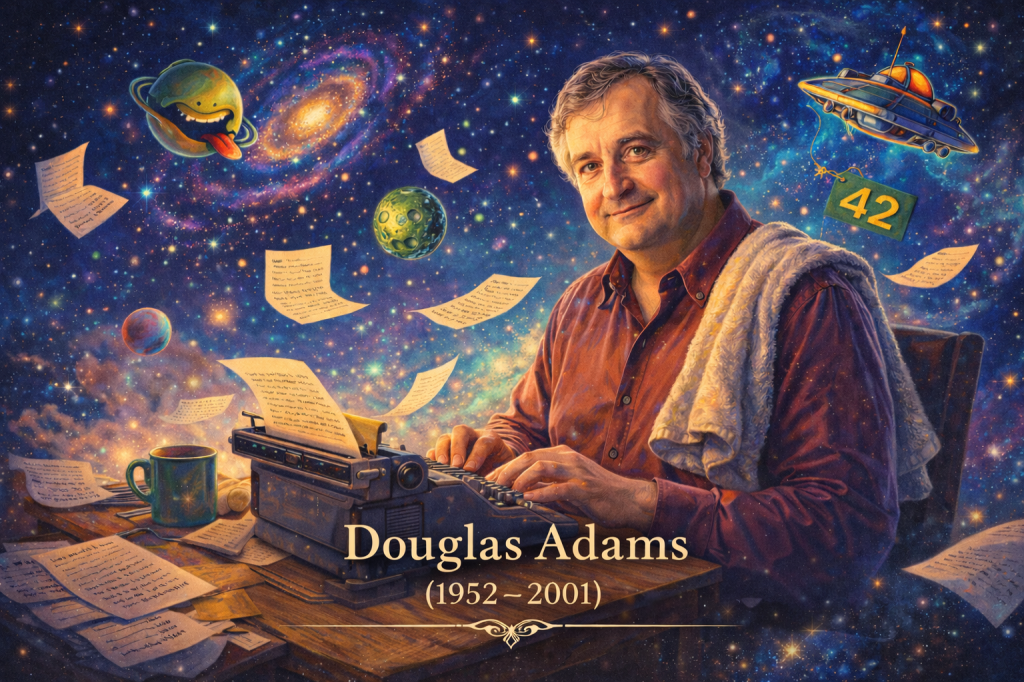
March 11, 1952
When Science Fiction Discovered the Power of Absurd English Humor
Born on March 11, 1952, Douglas Adams became one of the most distinctive comic voices in modern English literature. Best known for The Hitchhiker’s Guide to the Galaxy, Adams combined science fiction, satire, philosophy, and surreal humor into a style that reshaped comedic storytelling in English. His writing demonstrated that speculative fiction could be both intellectually playful and linguistically inventive, producing phrases, jokes, and narrative rhythms that became deeply embedded in modern English pop culture.
1. Creating Iconic Phrases That Entered English Pop Culture
Adams possessed a rare gift for coining lines that instantly resonated with readers. Several expressions from The Hitchhiker’s Guide to the Galaxy escaped the pages of the novel and became widely recognized cultural references.
Notable phrases and linguistic contributions include:
- “Don’t panic.” — the famously reassuring words printed on the fictional Guide’s cover
- “The Answer to the Ultimate Question of Life, the Universe, and Everything: 42.”
- “Mostly harmless.” — the Guide’s description of Earth
- “Infinite improbability drive.” — a deliberately absurd technological concept
- “So long, and thanks for all the fish.”
These expressions illustrate Adams’s ability to combine comic understatement, absurd logic, and philosophical wit within memorable English phrasing.
2. Transforming Comedic Science Fiction
Before Adams, science fiction in English was often serious, technical, or dystopian. Adams brought a radically different tone—irreverent, satirical, and joyfully absurd.
Key stylistic innovations:
- Blending cosmic-scale speculation with everyday British humor
- Using absurdity to critique bureaucracy, technology, and human behavior
- Treating the universe itself as a stage for comic misadventure
- Juxtaposing grand scientific concepts with mundane inconveniences
- Maintaining a playful narrative voice that frequently addresses the reader indirectly
This approach opened the door for a generation of writers who embraced humor as a legitimate mode within speculative fiction.
3. Expanding the Language of Comic Absurdity
Adams’s prose style helped popularize a distinctive form of English humor built around exaggerated logic, unexpected metaphors, and linguistic playfulness.
Common stylistic features of Adams’s writing include:
- Deadpan narration, where extraordinary events are described calmly
- Elaborate comic explanations that spiral into absurd conclusions
- Inventive pseudo-technical language describing impossible technologies
- Unexpected similes and metaphors with surreal imagery
- Playful manipulation of scientific vocabulary
Through these techniques, Adams demonstrated how English prose could transform scientific terminology into a vehicle for comedy.
4. Influence on Modern Nerd Culture and Geek Humor
Adams’s work became a cornerstone of modern science-fiction fandom and internet-era humor. His blend of wit, philosophy, and imaginative absurdity helped define a particular style of English-language geek culture.
Lasting cultural and linguistic influence includes:
- Popularization of humorous science-fiction dialogue and narration
- Frequent quotation of Adams’s lines in technological and online communities
- Integration of his jokes into computing culture and programming humor
- Inspiration for later comedic sci-fi works across novels, radio, television, and film
- The annual celebration of “Towel Day,” referencing a famous joke from his books
His influence continues wherever scientific curiosity meets playful irreverence.
Final Thoughts
Douglas Adams’s birth in 1952 marks the arrival of a writer who reshaped the tone of modern science fiction in English. By blending cosmic speculation with linguistic wit and philosophical comedy, he created a narrative style that remains instantly recognizable.
Through unforgettable phrases, absurd inventions, and a delightfully irreverent narrative voice, Adams proved that the vast universe of science fiction could also be a playground for the English language—and that sometimes the best advice for facing the cosmos is simply: don’t panic.
When the universe gets absurd, the best advice is still: Don’t panic.
 What Happened on This Day?
Leave a comment