
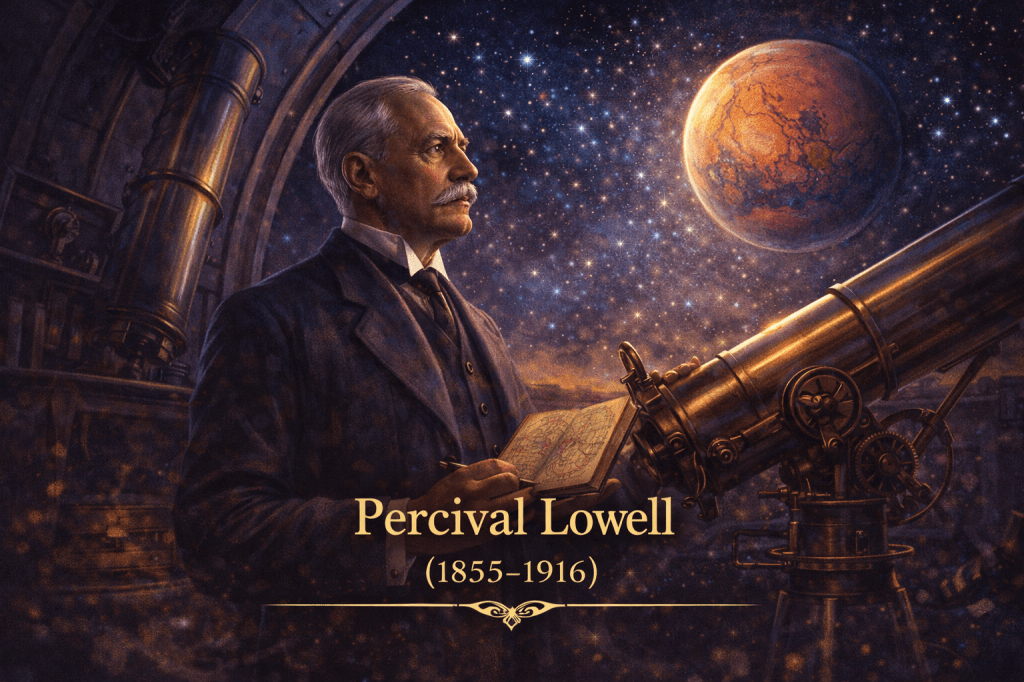
March 13, 1855
When Astronomy Began Speaking to the Public in Imaginative English
Born on March 13, 1855, Percival Lowell became one of the most influential popularizers of astronomy in the English-speaking world. An American astronomer, writer, and founder of the Lowell Observatory in Flagstaff, Arizona, Lowell wrote extensively about planetary science, especially the planet Mars. His books and lectures helped transform technical astronomical discussion into vivid, accessible English prose, bringing cosmic speculation into popular culture and influencing generations of readers, writers, and science communicators.
1. Popularizing Astronomy in Clear, Engaging English
Lowell played a major role in transforming astronomy from a specialized academic field into a subject widely read and discussed by the public. Through books such as Mars and Mars and Its Canals, he explained complex scientific ideas in language accessible to general readers.
Key linguistic contributions to science writing:
- Clear narrative explanations of astronomical observations
- Blending of scientific description with imaginative speculation
- Use of vivid metaphors to explain planetary features
- Accessible prose that avoided excessive technical jargon
- Expansion of public vocabulary related to astronomy
His work helped demonstrate that scientific writing in English could be both informative and captivating.
2. Introducing the “Canals of Mars” into English Cultural Vocabulary
Lowell famously argued that Mars contained a vast network of artificial canals, which he believed might have been constructed by an advanced Martian civilization. Though later proven incorrect, this idea had enormous cultural impact.
Terms and ideas popularized in English discourse include:
- Martian canals
- dying planet theory
- speculation about intelligent life on Mars
- descriptions of planetary engineering
- discussions of extraterrestrial civilizations
These concepts fueled public fascination with Mars and entered the language of early science fiction and speculative writing.
3. Inspiring Science Fiction and Speculative Writing
Lowell’s vivid descriptions of Mars strongly influenced writers imagining extraterrestrial worlds. His vision of a technologically advanced but declining Martian civilization became a recurring motif in early science fiction.
Writers influenced by these ideas include figures such as H. G. Wells, whose novel The War of the Worlds helped define modern alien-invasion narratives.
Literary consequences of Lowell’s influence:
- Expansion of English vocabulary related to alien civilizations
- Increased use of Mars as a central setting in speculative fiction
- Development of scientific speculation as a narrative device
- Blending of astronomy with imaginative storytelling
His work helped bridge the gap between scientific observation and literary imagination.
4. Shaping the Style of Popular Science Writing
Lowell’s books also contributed to the emerging genre of popular science, which aimed to make complex scientific ideas understandable to non-specialist audiences.
Characteristics of his prose style include:
- explanatory storytelling rather than purely technical exposition
- vivid descriptions of planetary landscapes
- rhetorical questions inviting reader curiosity
- a tone combining scientific authority with wonder
These stylistic techniques remain central to English-language science communication today.
Final Thoughts
Percival Lowell’s birth in 1855 marks the arrival of a writer who helped transform astronomy into a subject of public fascination. By presenting planetary science in vivid and accessible English, he expanded the vocabulary through which readers imagined the cosmos.
Even though some of his theories—such as the canals of Mars—were later disproven, Lowell’s influence endured. He helped make astronomy part of popular cultural conversation and inspired generations of writers to explore the universe through both science and storytelling.
When science met imagination,
the cosmos began speaking a language everyone could read.
 What Happened on This Day?
Leave a comment