
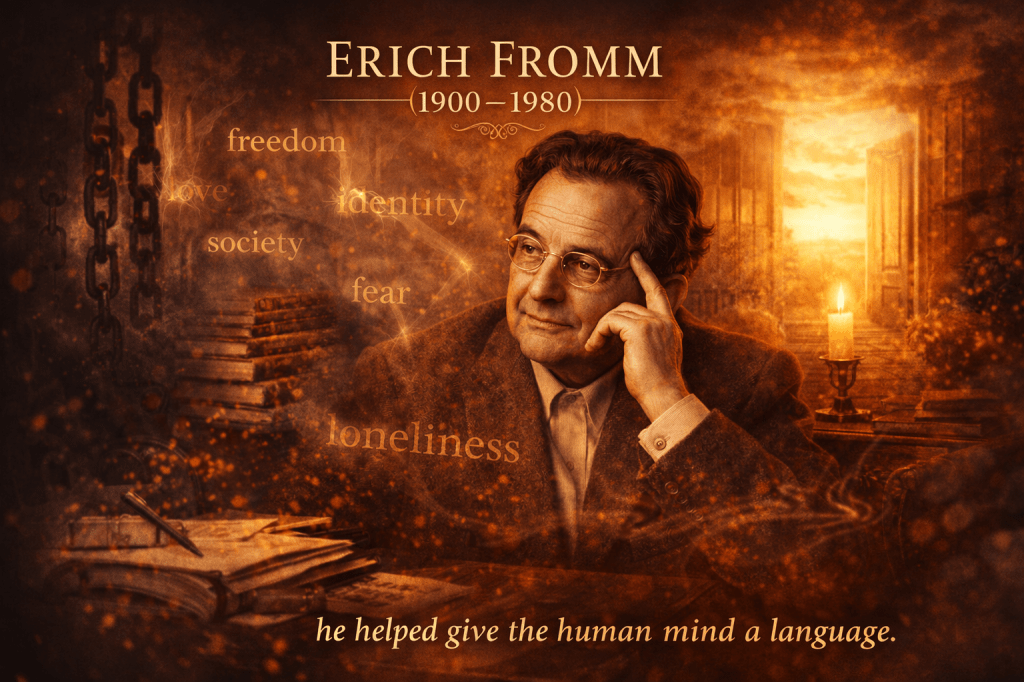
March 23, 1900
When Psychology and Philosophy Found a More Human Voice in English
Erich Fromm was born on March 23, 1900. He would become one of the most influential social psychologists and humanist thinkers of the twentieth century, and one of the figures who helped shape the modern English-language vocabulary used to discuss love, freedom, identity, and the individual’s place in society. Though born in Germany, Fromm later wrote many of his most important works directly in English, including The Art of Loving, helping bring psychological and philosophical ideas to a wide, non-specialist audience.
Fromm belonged to a generation shaped by war, political upheaval, and rapid industrial and social change. Writing in the United States, he did not write like a technical psychologist, but like a humanist concerned with the emotional and moral life of ordinary people. His language was clear, reflective, and accessible, and through it he helped create a new way of discussing human experience in English—one that combined psychology, philosophy, and social criticism.
1. Humanizing Psychological Language
At a time when psychology often relied on technical and clinical terminology, Fromm wrote in clear, readable prose that connected complex ideas to everyday human experience.
His linguistic influence includes:
- explaining psychological ideas in accessible language
- integrating everyday vocabulary with abstract concepts
- emphasizing lived experience rather than purely clinical description
- avoiding unnecessary technical jargon
- developing a vocabulary centered on emotion, meaning, and relationships
This approach helped make psychological ideas available to general readers, not just specialists.
2. Expanding the Vocabulary of Love, Freedom, and Identity
Fromm’s works helped popularize key concepts that became central to modern discussions of human behavior and social life. Many ideas that are now common in English-language discussions of relationships and identity were shaped or popularized by thinkers like him.
Important concepts associated with his writing include:
- love as an active practice, not just a feeling
- freedom and the burden of choice
- alienation in modern society
- the authentic self versus the socially conditioned self
- the tension between individuality and conformity
These ideas became part of the broader English-language vocabulary of psychology, philosophy, and cultural criticism.
3. Bridging Psychoanalysis and Social Thought
Fromm expanded the language of psychoanalysis by connecting it to social, economic, and cultural structures. His work moved beyond individual psychology to examine how society shapes human behavior and identity.
His linguistic and conceptual contributions include:
- combining psychological terminology with social analysis
- introducing discussions of authority, conformity, and power into psychological discourse
- framing mental health in relation to culture and environment
- expanding English discourse on the relationship between individual and society
- helping create a hybrid language of psychology, philosophy, and sociology
This interdisciplinary vocabulary remains influential in modern humanities and social sciences.
4. Influencing Popular and Academic English Discourse
Because Fromm wrote in a style accessible to both scholars and general readers, his ideas spread widely across different domains of English-language writing.
His long-term impact can be seen in:
- self-help and popular psychology literature
- academic discussions of identity and society
- modern conversations about relationships and personal growth
- the use of psychological vocabulary in everyday language
- a more reflective and introspective tone in English nonfiction
Through his writing, complex philosophical and psychological ideas entered everyday English vocabulary and discussion.
Why It Matters
The birth of Erich Fromm in 1900 marks the arrival of a thinker who helped reshape the language used to describe the inner life of human beings. By writing clearly about complex experiences—love, freedom, loneliness, identity, and responsibility—he helped create a more human-centered vocabulary for understanding the self and society.
Many of the words and concepts now commonly used to talk about relationships, personal growth, and modern life exist in part because thinkers like Fromm chose to write not only for specialists, but for everyone.
He did not just write about human beings — he helped give us the language to explain what it means to be one.
History shows when language changed.
At The English Nook, we explore how and why.
 What Happened on This Day?
Leave a comment